Showing posts with label Blogosphere. Show all posts

7.4.21

He's Done a Course

Back in my days editing the JME blog, we used to get the occasional unsolicited post sent to us.  Almost always, they went unpublished; this was overwhelmingly because they weren't very good.  The one person who did sometimes get his unsolicited work published was the ethicist-turned-barrister Daniel Sokol.  There was a number of reasons why we were a little more forgiving of him: he was someone we knew, and a reasonably well-known person in the field - he had a fairly regular column in the BMJ; his submissions, while sometimes a bit self-congratulatory, were often fairly inconsequential - but they were by the same token pretty harmless, so could tide us over during those periods when we had little to say of our own; and, finally, if we did reject his submissions, we could more or less guaratee that they'd appear on the BMJ's own blog anyway, so there wasn't much point our trying to act as gatekeeper.

A post by him appeared on the JME blog a few days ago, detailing the help he had been able to give a doctor, one Tarek Seda, who had found himself in professional trouble and facing a hearing from the Medical Practitioners' Tribunal Service in 2019.  This post purported to be a brief account by Dr Seda of how Sokol was tremendously helpful, andit was supplemented by an account by Sokol himself of how Sokol was... er... tremendously helpful.

Now, I do not know whose idea the post was - in the comments, Sokol writes that

[a]fter the outcome of the MPTS hearing, Dr Seda selflessly asked how he could help other doctors in a similar situation.   One suggestion was to write an article, giving a dual perspective on the process of ethics remediation: the doctor’s and the ethicist’s.   This blog is the product of that idea.

This tells us little about whose idea the post was, although I do have my suspicions - and I'll come back to that in a moment.  But it will not have escaped anyone's attention that the post as a whole does come across rather as an advertorial.  Evidence for this can be produced from the final sentence of the post proper, and the supplementary text that follows it:

2.8.20

Tracing Apps: Precaution and Paranoia


It's a little over a year since I last blogged anything.  Partly that's because I had other things on my mind, and nothing struck me as being the kind of topic about which I had much to say.  And then Covid-19 came along, and I still didn't have anything to say.
Could prior exposure to common cold viruses affect the severity of ...
Gratuitous virus image!  Yay!
I think that a lot of people don't have much to say about it; but that doesn't seem to have stopped them saying it anyway.  There's been a lot of nonsense.  And there's also been a lot of stuff that isn't nonsense, but that is nonetheless trivial, as people find an excuse to make their rather quotidian thoughts about consent or resource allocation or whatever relevant by sticking "... in the Time of Coronavirus" at the end of the title and bunging it off to a journal.  Hey-ho.  The REF's coming.  What do you expect?

The upshot is that I've been ignoring most of the CV-19 stuff; but every now and again, something catches my eye - such as this piece by Deena Davis on the Hastings Center blog: "Before We Turn to Digital Contact Tracing for Covid, Remember Surveillance in the Sixties", the conclusion of which is that "for me, digital contact tracing [through phone apps] is a bridge too far".

Why would this be?  The concern articulated has to do with the misuse of data.  Once you're being traced, who knows what'll happen to the data generated?  There are precedents for things happening with it that one might not welcome:
Do you remember when we discovered that Uber’s passenger app not only traced you to your destination, but continued to trace where you went after you exited the car?
And so the worry is that by installing a tracing app, one would potentially be handing over vast amounts of information to the government, which might use it for sinister ends.  For example, it might allow information to be gathered about immigration lawyers having met clients - presumably, not something that one would want to see.  Correspondingly, we might see other instances of governments prying into personal lives.  And this is at the root of the reason not to install the app.
In order to place such an app on my phone I would have to believe at least the following things: that the promised anonymity would be respected, that the government would not get hold of it, and that it would not be used to trace contacts for other reasons, e.g., to discover an immigration lawyer’s clients.
[W]e would need important safeguards against mission creep, whereby the surveillance app did not de-activate just because the pandemic was over. Perhaps the government discovers a new use for it; perhaps we kind of get used to it, the way we are used to the idea that our E-ZPass keeps a record of every toll booth we have gone through and our grocery store loyalty card keeps a record of the foods we buy.  [Ryan] Calo [has] noted that “clear, explicit rules are critical,” but what point are rules if the government clandestinely subverts them?
Well, OK.  But it's one thing to raise concerns about what a government might do nefariously with data gathered through a tracing app - quite another to take those concerns as settling matters.  For one thing, we have to ask ourselves whether governments actually would do that.  Perhaps they would.  Perhaps not.  It's notable that Davis doesn't really go beyond the "But what if..." stage of argument.  But that's a really cheap move.  We need to know more about the likelihood of this or that outcome.  ("But what if my writing this blog inspires a white supremacist murder?"  Well, I suppose there is a non-zero chance that it could, somehow.  But it's not likely.  It's not a reason not to write it.  The example is hyperbolic, but I hope it gets the point across.)

Let's stick with the immigration lawyer example.  It strikes me that there's a number of problems with this.  The first is that people who are concerned about deportation are likely to be among those least likely to download any kind of track-and-trace app to begin with.  And so - assuming I've understood the technology correctly and it'll be required for two phones to have it installed and active for it to work - there won't be a particular concern there.  Even if I've misunderstood the technology, anyone who is particularly worried would be able simply to turn their phone off for a bit, or leave it at home, or something like that.  This does undermine the efficacy of the app, for sure - and I'll come back to that point in a moment.  (The qualifier would have to do with instances in which apps are installed automatically, like U2 albums.  But if that's the case, there's nothing special about CV-19 apps, because presumably governments could install such apps anyway, and much more surreptitiously.)

In the meantime, it's also worth noting that there are rules about legal privilege that militate against the government making use of data gathered from such an app.  And while I'm not sure how powerful this point is - it's not obvious that there'd be a way to distinguish reliably between a lawyer and a client meeting in the office (which would be privileged) and their meeting in Starbuck's half an hour later (which wouldn't), the principle applies; and, of course, it people are bumping into each other in the coffee shop, then this is a "civilian" interaction anyway, so whether people are immigrants or lawyers would be neither here nor there.  They could easily be just people who happened to be close by at a given point.

"Ah, yes," the response might go, "It's true that the government would be in trouble if it subverted the rules on legal privilege; but so what?  By then it's too late.  And as Davis says, what point are rules if the government subverts them?"  And, superficially, this has a certain attraction as an argument - except for two considerations.  First, it militates against having rules on anything: if you've decided that they won't stop nefarious behaviour, you might as well not have them; and if you don't have the rules, then there's nothing about which to complain.  sequitur, second, that though the rules might not stop people determined to be bastards, their being there does give you a way to resist that bastardy.  That's an important point of principle.  So, for example, if you're an immigrant who's facing deportation because of the rule-breaking way an app was used, you'd have grounds for that deportation decision to be overturned or suspended, because there was (in effect) a due process violation.  Now, admittedly, it might be that when push comes to shove, this makes no practical difference.  But, as indicated, the point of principle would stand, and at the very least it would improve the prospects of other immigrants in a similar situation.

But a point that's more important than any of that is, I think, this: that the reason for having the app is important.  Davis doesn't say much about that, concentrating instead on the reasons to be suspicious of it.  But the examples she offers are examples of institutions using data for what we can take to be bad reasons.  It is prima facie undesirable for Uber to scrape data for commercial reasons.  It is prima facie undesirable for governments to try to sidestep legal norms when it comes to things like immigration (or anything else).  There does not seem to be a particularly compelling, or even good - by which I mean morally defensible - reason for either of those things to happen.

An app for exposure to CV-19 is different.  The underlying reason for that seems to be prima facie decent.  So even if there are reasons con as well, matters are different from how they appear in the examples offered.  We can't make sense of the desirability or otherwise of installing the app unless we give a full account of the reasons pro and con.  It might even be that we find the reasons for a CV-19 app unconvincing all told.  Nevertheless, there is a qualitative difference between it and the other examples Davis offers, precisely because there is a weighty moral reason for a CV-19 app that there isn't in other cases.

And this is where I go back to the point about lawyers switching off their phones for a while.  There is a reason not to.  But maybe, if the government is untrustworthy enough, there is a reason to do that.

If there are no particularly good reasons to install the app, then don't install it.  If the positive reasons not to are great, then don't install it.  But slightly vague appeals to the risk of state surveillance don't seem to me to carry much weight.


13.11.18

Academics Anonymous

The launch of a new academic journal doesn't normally attract much attention; but the launch of a journal that promises anonymity to authors who need protection, who who feel that they need it, because of the nature of their ideas has caused a bit of a stir.

I don't know most of the people involved; but I know some, and others are friends of friends.  No particular alarm bells are ringing.  (Francesca Minerva's name has been mentioned.  I'm not bessie mates with her, but I do know her professionally; she's whip-smart, as well as being a nice person.  On the other hand, she does have form when it comes to pressing for anonymity, and I articulated my concerns about her position at the other place... crikey.  Five years ago.)

I also know, and know of, a fair number of people who have faced appalling treatment for holding certain intellectual positions or advancing particular arguments.  Sometimes, those are positions and arguments that appear in peer-reviewed journals; I would be curious to know how much of the treatment comes from people who've read carefully the peer-reviewed papers about which they're protesting, as opposed to people who are outraged by proxy.  (Francesca wrote what I jokingly call The Paper Of Which We Do Not Speak and faced all kinds of abuse for it - much of it, I think, by proxy, after the Daily Mail and then Glenn Beck got hold of it.)  Sometimes they aren't positions articulated in journals; several academics that I know and respect have found themselves attacked for what seems to me to be the crime of being insufficiently woke on questions of gender and the law.

Either way, more often than not, as far as I can see, this treatment has come not from universities, but from civil - no: uncivil - society.  Universities have, at least sometimes, done the right thing in sticking up for academics.  This matters, because people receiving abuse for their positions are obviously people who have not been silenced and who - presumably - count as evidence against the case for anonymity.  Still, I can see how people might think that anonymity would be desirable, at least sometimes.  And there are anecdotes about people's academic careers suffering because of their intellectual commitments.

And yet I'm unconvinced by this journal, and for a number of reasons.


9.11.18

In it for the Money

Something I'd never realised about my job was that I've been missing out on the chance to turn into a cash-machine.

In the grand scheme of things, academic pay isn't bad... once you get established.  The problem is that getting established isn't easy: I was 30 before I'd ever earned enough to pay income tax, and it's got harder since then to get a foot on the career ladder.  Taking into account the level of student debt that new entrants'll've accrued, which are far higher than people of my cohort would have had, and the way that they're expected to have a portfolio of publications even before getting a job, I'm glad I'm not looking for a first job now.  Still, the point stands that, once you've got a foot on the ladder, the average academic salary is comfortably more than the average salary.  All the same: a bit more income on the side would never be a bad thing, would it?

Considerablay richer than yeow.
Daniel Sokol, writing on the JME blog, thinks that it should be possible to monetise medical ethics, and offers advice on how to do so.  Well, he might be offering advice.  He might simply be looking to tell the world that he's doing nicely, and tacking an advert for his book on at the end.  It's hard to know.  Anyway: he's got some suggestions.

I'm not going to rehearse what they are point by point, because that'd be tedious.  The gist is that there're thousands of pounds to be made if you happen to make the right moves.  But one wonders quite what planet he's on with the figures he quotes, and about the character that'd be required to make the moves that he recommends.

5.11.18

Edwards, Fuller and the Rule of Law

Phil Edwards posted a short essay on The Conversation a few days ago in which he articulates his concerns with the Counter-Terrorism and Border Security Bill, the latest piece of counter-terrorism legislation to be brought before Parliament.  This Bill, says Phil, was "justified" by Sajid Javid "as a way of ensuring that 'the police have the powers they need to protect us'".  Now, my hackles are already raised here because of the use of the word "justified" - Javid didn't justify the legislation thus, though he may well have attempted to do so.  To say that he justified it is to concede that his attempt was successful, and since Phil goes on to imply that the thinks that the Bill is open to serious criticism, Javid can't have justified it.  I know that a lot of lawyers use "justify" to mean "attempt to justify", or "defend", as well as... well "justify", but I do think that the distinction is important and worth maintaining.  I think that the lawyer's use of the word opens the door to a whole load of trouble.  After all, if you can't distinguish attempt from success in any enterprise, you're probably screwed.

But I digress... already.  Despite being less than a thousand words long, there's a lot crammed into Phil's piece.  Distilling the essence of the essay, I think that we'd end up with something like this:
  1. There are certain "precursor" activities that, though not terroristic in themselves, might nevertheless be subject to prosecution on the basis that they are precursors to terrorist activity.
  2. Laws that criminalise precursor activities may be worthy of our disapprobation in their own right.
  3. Such laws may be worthy of "second order" disapprobation, on the basis that they are (likely to be) inconsistently applied.
  4. This is because inconsistent application of a law is a violation of the Rule of Law.
  5. An appeal to Lon Fuller can help us understand the move from (3) to (4).
I want to concentrate here on one aspect - the final one - though there'll be the original shoutout to others.  But, in the spirit of being as candid as possible about my commitments, I suppose it's worth laying out a couple of responses to the parts Phil's argument that I'm going to bracket for now.  Thus, for example, I don't have any problem in principle with the idea of precursor crimes.  There're times when it seems to me perfectly proper to intervene to prevent a risk being realised.  While it's true that there's always a chance that a person planning to commit a crime might stop short of doing so even though fully prepared, it seems reasonable for the law to be concerned about that preparation.  Now, quite how prepared one would have to be in order to be the proper object of legal concern is a further question, and I'm not sure how the law ought to draw the line here.  I'm also not sure that it necessarily has to; setting out too rigid a list of criteria might force juries to convict the plain fantasist, and to acquit the genuine danger, simply because of the way the law has been drafted.

With that said, it is likely that we ought to worry about inconsistent application.  Whether that worry can be soothed, granted the idea that it's desirable to avoid rigid criteria for prosecution and conviction is uncertain.  It might be that the price we pay for desirable flexibility is the risk of inconsistency.  Whether or not that's a price we should pay is not immediately obvious; it needs more in-depth consideration than I can give it here.  Maybe we have to pay attention to the distinction between apparent and actual inconsistency, on the understanding that instances of the former may not be instances of the latter.

One thing that would seem to make the price too high would be an erosion of the Rule of Law tout court.  A world in which nobody can be certain whether and how the law will respond to their actions is a world in which the Rule of Law seems not to obtain: rather, we'd have the Rule of Agents of Law, or Rule of Prosecutors, or Rule of Judges, or something like that.  And this is where Fuller comes in.

13.10.17

Persian and Provincialism

It's been a while since I posted a Persian update here; it was difficult to keep much momentum when the basic alteration from one week to the next was "Learned a bit, forgot a bit, didn't make much progress".  I didn't complete any of my summer exam because I looked at the page and simply couldn't read a word of it.  It took me a while to un-freeze my brain; and by that time, the semester was over and there were no lessons.

My erstwhile teacher has said I should come along to the next level of lessons all the same; but I don't think I'd be up to it - and, anyway, they don't fit easily with my other commitments.  I may resit the beginners' course in semester 2.

In the meantime, and in addition, I've found another Persian teacher, with whom I'm having one-to-one lessons via skype.  Slowly, slowly, I'm making up ground.  But... well, you know there's going to be a but.

It turns out that what I'd been learning at the University last year was very, very formal and rather outdated; were I to turn up in Tehran and speak to people, it'd be somewhat as if Jane Austen were to materialise here.  OK: I'd be understood, but people'd be puzzled, and I might not understand them too well.  What I'm learning now is much more colloquial.  Pronunciation is slightly different, with syllables dropped or contracted into each other; some of the long alephs become vavs, too: thus, for example, "they", آنها (anhā), becomes اونا (unā).  I've also learned that a lot of people really struggle with dipthongs including the vav - many younger Iranians wish it'd just go away.  Thus "sister", خواهر (khahar), is sometimes contracted to خاهر, on the basis that the و doesn't do anything.  If you're sending a text, those spare characters can be important!  Granted, this kind of shift isn't the sort of thing about which I have to worry a great deal, but the point stands that classroom Persian and everyday Persian sometimes come apart.

(Incidentally, I struggle to pronounce خواهر, however you want to spell it.  It's something like khahar; but there's something about the differentiation of the "kh" sound of the خ, and the "h" of the ه that I struggle to make, and I keep pronouncing the first "a" more like "ar", too.  I don't know why I have a mental block about it - but, on the other hand, I don't have a sister either, so it may not matter much all things considered.)

On a slightly deeper level, most verbs in the simple present are indicated by the prefix mi-.  Hence "To come", آومدن (amadan), becomes man mi'am, to mi'ai, u mi'ad for I/ you/ he or she come(s); "To eat", خوردن (hourdan) becomes man mi'houram, to mi'houri, u mi'houreh.  But some aren't: for example, "To have", داشتن (dāshtan) becomes man daram, to dari, u dareh - except when it doesn't; hence one could say "man mi'daram" for "I have", and people'd think you're from Shiraz, because Shirazis do use the mi- prefix.  (Note that the ending of the third person singular is something else that shifts is colloquial Persian; I'd initially learned that verb endings were basically -m, -i, -d, -im, -id, nd; but they're often, albeit not always, -m, -i, -eh, -im, -id, -n in real life.)

10.10.17

"Top of the Lake" may Sink as a Procedural, but Look Beneath the Surface

A couple of weeks ago, BioNews invited me to review Top of the Lake; this is the version I submitted there, free - for better or worse - of editorial cuts.

There's a moment in the final episode of this second series of Jane Campion's Top of the Lake where Nicole Kidman's character Julia reminds Elizabeth Moss's character Robin, a policewoman and our protagonist, that she, Julia, is the 'real mother' of Mary (Alice Englert), the troubled and endangered young woman at the centre of the drama. Mary is adopted: Julia raised her, whereas Robin merely gestated her. An argument about exactly what it means to be a mother is not only important in the relationship between Robin and Julia: it is key to the main plot of the drama.

A body has been found washed up on a Sydney beach, and is discovered to be that of a Thai woman working in one of Sydney's legal brothels. The dead woman was pregnant when she died, but the baby is not genetically related to her; episode 2 ends with Robin's realisation that the dead woman was acting as a surrogate. What follows is a story that weaves together the rather murky worlds of the legalised sex trade and commercial surrogacy, which is illegal under New South Wales law.

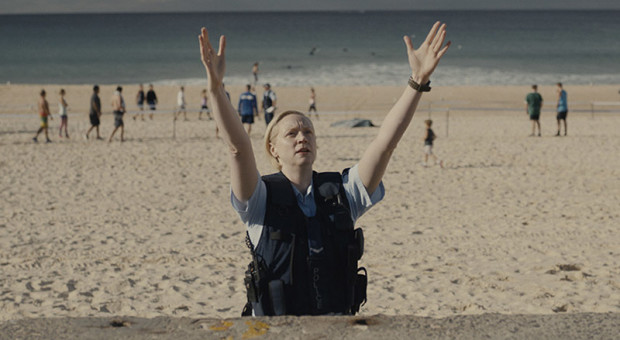
Hands up if you shouldn't be working this case!
Now, it’s worth interjecting at this stage with the observation that, if there’s one thing we learn from Top of the Lake, it’s that Australian police have some very sloppy procedures and conflict-of-interest regulations. Gwendoline Christie plays Miranda, with whom Robin is partnered in the investigation; Miranda is not only having an affair with her boss, but is also trying to have a baby by surrogacy with him. Worried that the foetus taken from the dead woman might be her own, Miranda has a bit of a barney at the office of the clinic that she patronised (matronised?). This strikes me as the sort of thing that might see a real police officer removed from a case, at the very least; but nothing at all is mentioned about it. Police officers having affairs with each other? I’m sure that happens. Police officers engaging surrogacy services? Likewise. Police officers investigating a case that straddles the boundary between legal and illegal surrogacy, at the behest of a commanding officer with whom they are trying to start a family by means of a legally-iffy surrogacy service? Is there no oversight here? At the same time, via Puss, the none-more-sleazy pimp played by David Dencik who has something to do with the illegal surrogacy racket and with whom Mary is besotted, the story is also very personal for Robin – just as was the story in the first series of Top of the Lake. Again: should she really be working on this case?

Maybe there is method in writer/ director Jane Campion’s plotting. There is a good point to be made about how our attempts to separate the private/ personal and the public/ political can only ever be partial, and that it’s often in women’s lives that we see the intersection most clearly. But there’s also a risk here of Robin becoming a slightly rough-at-the-edges Miss Marple: someone around whom Bad Things keep happening, and with whom you probably wouldn’t want to spend too long in a country house. Whether a third series of TotL would be possible without characters becoming mere ciphers for political points is unclear.

Admittedly, it’s a bit early to worry about the plausibility of a programme that might not ever be made; and the implausibilities of this series (or what one hopes, for the sake of effective policing in Australia, are implausibilities) ought not to detain us too long. For there are deep and troubling questions that the series raises.

15.8.17

Brexit, Fraud, and Law - update

A little over a year ago, I posted something about someone who had set up a crowdfunder campaign to bring a prosecution over Brexit.  I was not impressed.  I concluded by saying that the person behind it, one Marcus Ball, "should think very carefully about whether to keep his campaign going".  Of course, I'm not pompous enough to think that my opinion on this stuff counts for much, or that it'd make any contribution, or that Ball would even have read the post.  But if everyone with a blog allowed that to stop them, there'd be nothing on the internet.

I thought I'd have a look at what he's up to now.  There's still a website, but the clearest updates seem to be on the crowdfunder page.   Ball reached his initial target, so one might wonder what progress he'd made in his case.  The answer would seem to be... er... not a heck of a lot.  It appears that he contacted some lawyers, who told him in January that he didn't have a case, and he then went back to them in February with a 25 000-word document and had persuaded them that he did after all by March.  He is, though, unclear about what the legal objections were, and about how he overcame them.  One wonders why, if he is that much more competent than the lawyers he's hired at the expense of 6 000 donors, he needed them in the first place; but that's for another day.  Since then, he's written for his lawyers another pair of documents; one is 22 000 words long, and the other 10 000 words.  They must love him.  He's now asking for more money (some of which will fund a salary for him).  Hilariously, after the latest update on the BrexitJustice crowdunder, he adds a note:

11.8.17

Charlie Gard: An Ethical Analysis of a Legal non-Problem

(This is an extended version of a post that originally appeared at EJIL: Talk!)

For those with an internet connection and an interest in current affairs, the story of Charlie Gard been hard to avoid recently. A decent précis is available here; but it’s worth rehearsing.

Shortly after his birth, Charlie’s health began to deteriorate, and he was diagnosed with a terminal and incurable mitochondrial DNA depletion syndrome. By March 2017, Charlie needed artificial ventilation, and doctors at Great Ormond Street Children’s Hospital (GOSH) applied to the High Court for confirmation that removing that ventilation would be lawful, having judged that it was not in his best interests. This was contested by his parents, Chris Gard and Connie Yates; the High Court ruled in favour of GOSH. This was confirmed by the Supreme Court and the European Court of Human Rights. During all this time, Charlie remained ventilated.

In the High Court, Mr Justice Francis said that his decision was subject to revision should new evidence emerge favouring continued treatment; in July, Charlie’s parents returned to the High Court, claiming that Charlie might benefit from an experimental treatment being offered by Professor Michio Hirano of Columbia University. However, as proceedings advanced, it became clear that Hirano’s proposed treatment had never been used on patients like Charlie, that he had neither seen Charlie nor read his notes when he offered the treatment, and that he had a financial interest in that treatment. The position statement issued by GOSH on the 24th July barely hides the hospital’s legal team’s exasperation. On the 24th July, Charlie’s parents dropped their request for continued treatment. The details of Charlie’s palliative care were still disputed; his parents wanted it to be provided at home, with ventilation maintained for a few days. The High Court ruled against this on the 27th July. Charlie was moved to a hospice; his ventilator was removed, and he died on the 28th July, a few days before his first birthday.

The way this case has played out has not been pretty. Elements of the American media (this piece is one among many) and the political right wing used it to launch attacks on single-payer healthcare systems: Nigel Farage weighed in, complaining about the state taking away parental rights: From the left, Giles Fraser wrote that the case was being dealt with too rationally. None of these claims is justified, and many left-leaning people have been surprised to find themselves in agreement with Melanie Phillips on this matter.

Legally, the case was very straightforward.

14.4.17

Law Changes and Slippery Slopes

(Cross-posted from the other place)

Apparently, there was a TV programme in Australia the other day in which a there was a discussion of assisted dying.  It got reported in The Guardian, largely on the basis that an 81-year-old audience member kept calling Margaret Somerville "darling" and then got mildly sweary.  I've only seen those clips from the programme that are linked in the Graun's report, so I'm not going to comment on the tone of the debate in particular.  Rather, I'm interested in one of the responses to the programme, from Xavier Symons, writing in The Conversation.

Symons takes the opportunity to unpick the idea of a slippery slope argument - in this case, the claim that allowing some forms of assisted dying will commit us to allowing... well, that's open-ended, but it's sufficient to say that it'd be terrible.  We'd want to avoid terrible things; therefore, the argument goes, we shouldn't allow any of it.  This is well-worn stuff in the seminar room, but it's a mode of argument that refuses to die.  Quite correctly, Symons points out that
there is a need for empirical evidence or sound inferential reasoning to support the claim that event B will necessarily (or probably) follow on from event A.  Without this evidence, the argument is invalid. I can’t just claim, for example, that the legalisation of medicinal marijuana leads to the legalisation of ice - I need to show some empirical or logical connection between the two.
So far, so standard.  (I'd say "unsound" rather than "invalid", because the validity of an argument doesn't depend on its evidence - or, at least, not in the same way; but that's a small matter.)  He then makes another move, which is a bit more interesting:
But (and it’s a big but) there is such a thing as a good and valid slippery slope argument.  A good slippery slope argument demonstrates a causal or probable relationship between event A and B, such that event B can legitimately be expected to occur if event A is allowed to occur. [...] There are, nevertheless, compelling empirical and logical slippery slope arguments available to defend more modest claims about the “normalisation” of assisted dying.
Is this correct?

2.8.16

Free Labour and Quiet Doubts

(Originally posted on 1.viii.16 at the other place.)

Those of us on the academic side of things will almost certainly recognise the situation: you're sitting in your school's Teaching & Learning committee, or a staff/student committee meeting, or something like that, and you hear the complaint from students that they should get more contact time.  Academics should spend more time teaching rather than simply doing their own research.  After all, they're paying however-many thousand pounds for their education.

And you'll've heard the standard rebuttals - and maybe even trotted them out yourself: that course fees cover not just teaching costs, but libraries, labs, buildings and so on; that university learning isn't about hours in a classroom; that teaching and research are intertwined; that students benefit from being taught by the people who're writing the papers they're reading.  But I wonder if these standard responses miss something important.

Back in April, I was getting companionably smashed with some of my final-year students, and we were talking about what they were going to do when they'd graduated, and about possible careers.   One or two were interested in academia, and so a part of the conversation concerned what life's like from my side of the fence.  Predictably, pay was one thing that interested them.  I mentioned that I'd made about £80 in total from the books I've written, spread over 10 years.
"And what do you get paid for a paper?"
I held back my bitter laughter, and explained how much you get paid for papers, and how much you get for peer-reviewing, and all the rest of it.  The students had had no idea that this stuff was expected of us, but not remunerated.  Why would they?  Indeed, isn't it insane that we're not paid?

I think that one gets an insight here into students' complaints about academics' priorities being wrong.   If they think that we get paid for publishing papers, then of course they're going to think that we have an incentive to resist extra contact hours - and everything we tell them about extra contact hours being at best academically unnecessary, and likely as not counterproductive, will sound like so much bad faith.  After all, of course we'd tell them that a course only needs 30 hours of lectures rather than 60 if we could be earning extra money with those spare 30 hours.

What prompts all this is an article in the Chronicle of Higher Education.   It's from 2012, but it's started popping up in my social media timelines this morning, and Carl posted it on Fear and Loathing in Bioethics last night.  It makes a proposal:

22.7.16

Hate Thy Neighbour

Over at the other place, I've written a couple of times over the years in response to posts on the Christian Medical Fellowship's blog.  (Now I look, it's more than a couple.)  I have a strange fascination with it, you see.  But the fact that the other blog is associated with an august academic body means that I have to restrain myself.  I don't think I have to do that here.

First, though, why do I have it on my RSS to begin with?  Well, there's something about the combination of utter bewilderment by the world, the staggering poverty of the reasoning, the ability to misunderstand things that're really quite straightforward, and a compulsion to crowbar a Biblical verse into every second paragraph that I find compelling.  But the fundamentalism does sometimes grate; some of the attitudes there are - to use a word that the contributors there almost certainly think relates to actual historical fact - antediluvian.  And they stop the posts being quite as funny as they might be.

Peter Saunders' latest is a grotesque example of all that's wrong with the CMF.  "We live in times when the very foundations of our civilisation are being destroyed," he begins.
[T]he NHS with its burgeoning needs and shrinking budgets, mounting national debt, political and economic uncertainty following ‘Brexit’, the threat of Islamic fundamentalism, creeping atheism and secular humanism.
See the problem here?  The utter lack of perspective?  Even if you think that these things are bad - on which, more anon - I'd wager that the very foundations of our civilisation are not being destroyed.  At most, they're changing.  Saunders has form when it comes to secularism, though.  It's one of the things he simply doesn't understand.  He's used the phrase "secular fundamentalism" as though it actually exists, for example (in a piece that offers a defence of the pointless genital mutilation of male children, to boot).  He thinks that Britain is "slid[ing] into secularism".  He doesn't seem to notice (a) that secularism is perfectly compatible with Christianity - and arguably draws some of its intellectual strength from the Christian idea that one should render unto Caesar that which is Caesar's, and unto God that which is God's: a doctrine that is quite possibly an early call for a separation between religion and politics; (b) that, as such, a commitment to secularism is precisely the thing that guarantees his right to publish this gibberish irrespective of prevailing religious views; and (c) he is in no way representative of what most Christians think anyway.  (Maybe he's a bit takfiri when the mood takes him.)

But then again, I've thought for a while that there's the whiff of the theocrat about Peter.  I thought I'd written something to that effect elsewhere, though I can't seem to find it right now.

4.4.16

Why India? Why Brits?

Cross-posted from the other blog.

Julie Bindel had a piece in The Guardian the other day about India's surrogate mothers.  It makes for pretty grim reading.  Even if the surrogates are paid, and are paid more than they might otherwise have earned, there's still a range of problems that the piece makes clear.

For one thing, the background of the surrogates is an important factor.  Bindel writes that
[s]urrogates are paid about £4,500 to rent their wombs at this particular clinic, a huge amount in a country where, in 2012, average monthly earnings stood at $215.
It's tempting, at first glance, to look at the opportunity to be a surrogate as a good thing in this context: these women are earning, by comparative standards, good money.  But, of course, you have to keep in mind that the standard is comparative.  If your choice is between doing something you wouldn't otherwise do and penury, doing the thing you wouldn't otherwise do looks like the better option.  But "better option" doesn't imply "good option".  So there's more to be said there; more questions to be asked.  Choosing x over y because y is more awful doesn't mean that x isn't.  It might be a good thing; but it might not be.  There might be economic - structural - coercion.  Choosing to become a surrogate might be a symptom of there being no better alternative.

A related question is this: are the women really making a free choice in offering their reproductive labour even assuming that the terms are economically just?  Possibly not:
I have heard several stories of women being forced or coerced into surrogacy by husbands or even pimps, and ask Mehta if she is aware of this happening.  “Without the husbands’ [of the surrogates] consent we don’t do surrogacy."
Note (a) the non-denial, and (b) the tacit acceptance that it's the husband's decision anyway.  That's not good.

(In a wholly different context, I've recently been reading David Luban's Lawyers and Justice, and - in a discussion about lawyers cross-examining complainants in rape cases, he makes this point:
([H]ere we have two people who are confronted by powerful institutions from which protection is needed.  The defendant is confronted by the state [that is: in any criminal trial, the defendant does need protection from the power of the state - IB], but the victim is confronted by the millennia-long cultural tradition of patriarchy, which makes the cliché that the victim is on trial true.  From the point of view of classical liberalism, according to which the significant enemy is the state, this cannot matter. But from the point of view of the progressive correction of classical liberalism, any powerful social institution is a threat, including diffuse yet tangible institutions such as patriarchy. (p 151)
(The sentiment would seem to apply here.  A view of human agency that sees liberty as being mainly or only about avoiding state interference is likely to miss all kinds of much more subtle, insidious pressures that are liberty-limiting.  Economic factors are such pressures.  The idea of the wife as property is another.)

I do wonder if readers of this blog might help out with answering one more question, though. One of the startling claims is that
[a]pproximately 12,000 foreigners come to India each year to hire surrogates, many of them from the UK.
I don't know how many "many" is, but let's take as read that it's more than none.  It's a statistic that raises a question for Ophelia Benson over at Butterflies and Wheels:
Why India? Why not hire surrogates at home?
Because India has a lot of poor people, that’s why. Because the price is a fifth of what it would be at home. Because it’s a perfect setup for rich pale people to exploit very poor brown women.
I don't think that that's quite got it.  As I commented on Ophelia's piece, this wouldn’t easily explain the UK factor.  As the article makes clear, commercial surrogacy is illegal here; surrogates are allowed only to recoup reasonable expenses.  Surrogacyuk.org suggests £7000 – £15000 as a guide for the “price” (I know I shouldn't use that word, but you know what I mean) in the UK; but if Indian surrogates are paid £4500, and the clinic is still making up to £18000 on the transaction (assuming I’ve not misread the article), the Indian market is likely to be more expensive for commissioners, even without the cost of travelling to India to begin with.

So why do Brits use Indian surrogates?

Here's a hypothesis.  In the UK, surrogacy arrangements aren’t enforceable, the woman who gives birth is automatically recognised as the mother, and a Parental Order is required for the commissioning mother/ couple to be legally recognised as having parental status.  I don’t know what the legal niceties are in India, but my guess is that that side of things is probably a bit easier to deal with.  After all, if the procedure there is as free-wheeling as Bindel suggests, keeping track of exactly who gave birth to whom and with whose eggs isn’t going to be foolproof.

Is that it?  Is there any other reason why people from the UK might commission an Indian surrogate mother?

27.2.16

Mature Content?

This is a slightly longer version of a post I've just published on the other blog.

There's an aisle at the supermarket that has a sign above it that reads "ADULT CEREALS".  Every time I see it, I snigger inwardly at the thought of sexually explicit cornflakes. (Pornflakes.  You're welcome.) It's not big, and it's not clever: I know that. But all these years living in south Manchester have taught me to grab whatever slivers of humour one can from life. Anyway... A friend's FB feed this morning pointed me in the direction of this: a page on Boredpanda showing some of the best entries to the 2016 Birth Photography competition. (Yeah: I know. I had no idea, either.)

I guess that birth photography is a bit of niche field.  The picture that one "Best in Category: Labour" - which you can see here - is, for my money, a brilliant image.  Some of the compositions are astonishingly good - but then, come to think of it, childbirth isn't exactly a surprise, so I suppose that if you're going to invite someone to photograph it, they're going to have plenty of time to make sure that the lighting is right.

A second thought that the pictures raise is this: no matter how much people bang on about the miracle of birth... well, nope.  Look at the labour picture again. I can't begin to express how glad I am that that's never going to happen to me; and I'm even more convinced than I was that I wouldn't want to play any part in inflicting that on another person.  (I think that there's all kinds of reasons why I have a duty not to reproduce, from overpopulation to the fact that I don't think it'd be desirable for a migrainous thicko like me to beget another generation of migrainous thickos; but not abetting that kind of agony in another human being is also on the list.  Fortunately, since it's unlikely that anyone would want a migrainous thicko to play any part in siring her child in the first place, this is not a problem I'm likely ever to encounter in practice.)

But my overriding response is something in the realm of astonishment that some of the pictures are blanked out as having "mature content".

I mean... really?

5.1.16

Saving Money is Easy.

Here's a bit of silliness that's just popped up on my FB feed: something called the 365 Day Penny Challenge.

Want to know the easiest way to save £667.95 in a year?
Then I’ve got the thing for you…
The 365 Day Penny Challenge.
All you need is:
  • A jar 
  • Pennies 
  • Will Power
Day 1 (usually 1st January) put 1p in the jar, the next day (Day 2) put 2p in and so on and so forth. 
At the end of the 365 you will have save[d] £667.95! 
You're not doubling what you save; day 3 would involve putting in 3p, day 100 £1, and so on.

All groovy... except I doubt that it's sustainable.  A person could quite easily have, say, £3 in their pocket to put into the jar on day 300.  But that they'd have almost £3 on day 299, AND £3 on day 300, AND £3.01 on day 301, and so on looks to me to be more of a stretch.  (That'd amount to over £21 in loose change over the course of a week.)

If you do have that amount of loose change every day, I suspect it's because you're going to the bank and taking out £5 every day, some of which you spend on odds and sods.  But you're still taking out £5.  Banking the change - which is in effect what you're doing by putting the change in a jar - is not making a saving.  It's just a matter of not spending the change.

Genius.

People are sharing this and calling it a good idea.

Besides: who pays for everything with cash anyway?  The whole premise of this rests on the idea that you're going to be forced to take money out from the bank every day in fixed denominations greater than you would want to spend (unless you're withdrawing money just so that you can put it in your jar, which is ridiculous).  But Tesco and pubs all take plastic now.  Hell, even my milkman takes a direct debit.

In other words, the idea isn't just capitalising on people withdrawing cash in fixed denominations greater than they would want to spend; it requires it, in the face of there being much more efficient and secure ways to buy stuff.  The only people for whom this could conceivably work are in the cash-in-hand economy.  For people who aren't my window-cleaner or builder... it's a bit dim.