Showing posts with label Thinking aloud. Show all posts

11.8.22

The Academic Merit of "What I Did on my Holidays"

There are no frequent or regular readers of this blog, because it is updated so infrequently and irregularly.  It takes a lot to get me to add anything.  Quite often, a longish thread on Twitter is as close as I get to blogging these days.  But sometimes, things need a bit more working-out.  Things such as this paper, "I am not Alone – We are all Alone: Using Masturbation as an Ethnographic Method in Research on Shota Subculture in Japan" by Karl Andersson, published in the journal Qualitative Research, which has attracted a fair bit of attention on social media in the past few days on the basis of a tweet from the Tory MP and culture warrior Neil O'Brien - a tweet that led a number of equal-but-opposite culture warriors to decide that since he'd condemned it, it must be worth defending (and then, at least sometimes, walking it back, as here and here; others have simply deleted their tweets in defence, presumably in the hope that we'll forget them.)

But Twitter is a notoriously more-heat-than-light sort of place, and so I decided to read the paper for myself, and to put myself in something like the position of a peer-reviewer.  Is the paper actually any good?  Does it have academic merit?

I don't think it does, and I'll explain why in a moment.  But first, a few things should be noted.

7.4.21

He's Done a Course

Back in my days editing the JME blog, we used to get the occasional unsolicited post sent to us.  Almost always, they went unpublished; this was overwhelmingly because they weren't very good.  The one person who did sometimes get his unsolicited work published was the ethicist-turned-barrister Daniel Sokol.  There was a number of reasons why we were a little more forgiving of him: he was someone we knew, and a reasonably well-known person in the field - he had a fairly regular column in the BMJ; his submissions, while sometimes a bit self-congratulatory, were often fairly inconsequential - but they were by the same token pretty harmless, so could tide us over during those periods when we had little to say of our own; and, finally, if we did reject his submissions, we could more or less guaratee that they'd appear on the BMJ's own blog anyway, so there wasn't much point our trying to act as gatekeeper.

A post by him appeared on the JME blog a few days ago, detailing the help he had been able to give a doctor, one Tarek Seda, who had found himself in professional trouble and facing a hearing from the Medical Practitioners' Tribunal Service in 2019.  This post purported to be a brief account by Dr Seda of how Sokol was tremendously helpful, andit was supplemented by an account by Sokol himself of how Sokol was... er... tremendously helpful.

Now, I do not know whose idea the post was - in the comments, Sokol writes that

[a]fter the outcome of the MPTS hearing, Dr Seda selflessly asked how he could help other doctors in a similar situation.   One suggestion was to write an article, giving a dual perspective on the process of ethics remediation: the doctor’s and the ethicist’s.   This blog is the product of that idea.

This tells us little about whose idea the post was, although I do have my suspicions - and I'll come back to that in a moment.  But it will not have escaped anyone's attention that the post as a whole does come across rather as an advertorial.  Evidence for this can be produced from the final sentence of the post proper, and the supplementary text that follows it:

26.8.20

Racial Self-Awareness?

A quick query for philosophers and bioethicists.

I've just had cause to revisit Mary Anne Warren's "On the Moral and Legal Status of Abortion", which is where she sets out her five criteria for recognising a creature as a person:
I suggest that the traits which are most central to the concept of personhood, or humanity in the moral sense, are, very roughly, the following:
(1) consciousness (of objects and events external and/or in ternal to the being), and in particular the capacity to feel pain;
(2) reasoning (the developed capacity to solve new and relatively complex problems);
(3) self-motivated activity (activity which is relatively independent of either genetic or direct external control);
(4) the capacity to communicate, by whatever means, messages of an indefinite variety of types, that is, not just with an indefinite number of possible contents, but on indefinitely many possible topics;
(5) the presence of self-concepts, and self-awareness, either individual or racial, or both.
That final six words is bugging me.  What does she mean by "racial"?  It's not used anywhere else in the essay.

That said, the word "race" does appear - again, just the once.  A little earlier, setting out her stall, she had asked us to
[i]magine a space traveler who lands on an unknown planet and encounters a race of beings utterly unlike any he has ever seen or heard of. If he wants to be sure of behaving morally toward these beings, he has to somehow decide whether they are people, and hence have full moral rights, or whether they are the sort of thing which he need not feel guilty about treating as, for example, a source of food.
The emphasis is mine.  So maybe that's it: the word "race" here is used in the same sort of way that we might use it in phrases like "human race".  That being so, the word "racial" would presumably have to be taken to be used in the same sort of way.  Warren isn't being weird about ethnicity.

No ethnicity, no.  But weird all the same.  What on Earth does she mean by "self-awareness, either individual or racial, or both"?

I can tell what individual self-awareness would be.  It's self-awareness in the everyday sense of the term.  But what would "racial self-awareness" be?  Whether we're talking about species or ethnicity, I'm equally mystified.  Inasmuch as that it's not individual, what is the "self" of which one is supposed to be aware?

It can't be a pervasive sense of being human: that would be a bonkers thing to suggest as a criterion for personhood.  Partly, that's because it's not something that'd be apparent to the visitor from another world, so not something that could help decide whether we're persons or not.  Then again, consciousness (of pain) isn't visible to outsiders.  But we can report things like that to people who ask the right questions.  But "racial self-awareness" is not obviously the sort of thing about which our visitor could ask us, or about which we could provide an answer.  If someone asked me if I had racial/ species self-awareness, I'd have to say not, because it's not something I understand.  I don't have a pervasive sense of belonging to the human race, and I don't think that anyone has.  Such a thing seems impossible to pin down, and so adds nothing to our descriptions of our mental state.  How would I distinguish the bit of my self awareness that was human from the bit that was just me?  I don't think I could.  I don't think there is anything; and even if there is, it's not something about which we can say anything, which amounts to the same in this case.

And so there we are.  I don't think it's a big thing; it doesn't really make any difference to Warren's argument.  But I'm curious.  What's she on about?

18.8.20

So What Happens Now?

 Gavin Williamson is a sorry excu...  No, wait.  I'll start again.

Gavin Williamson is sorry.  He's been wandering around the various news studios leaving great big apologies right in the middle of the floor where everyone can see them.  He's very sorry for the A-Level debacle.  It's tempting to feel sympathetic for a moment - after all, the coronovirus shutdown is unprecedented, and so there'll've been difficulties.  But the moment of sympathy is very short, because although the hope of running the summer exams as normal might have been on the table back at the beginning of March, it should quickly have become apparent that that was not going to happen.
And even if in April the government had been clinging to that hope, they ought to have realised that there was a good chance that there'd have to be something else up their sleeves as a fallback.
And then after the debacle in Scotland last week...  Oh, you get the idea.
Nobody really minds things being up in the air at the moment.  Nobody really minds plans being undermined by reality.  What we do mind is governments that don't seem to have thought more than two days ahead.  A plan that can't come to fruition is better than no plan at all.
But, anyway.  A-Level students have something approximating a result, and hopefully most of them will get into university, which is all peachy... unless you're a university.
Just off the top of my head, let me try to explain some of the problems we're going to have.

2.8.20

Tracing Apps: Precaution and Paranoia


It's a little over a year since I last blogged anything.  Partly that's because I had other things on my mind, and nothing struck me as being the kind of topic about which I had much to say.  And then Covid-19 came along, and I still didn't have anything to say.
Could prior exposure to common cold viruses affect the severity of ...
Gratuitous virus image!  Yay!
I think that a lot of people don't have much to say about it; but that doesn't seem to have stopped them saying it anyway.  There's been a lot of nonsense.  And there's also been a lot of stuff that isn't nonsense, but that is nonetheless trivial, as people find an excuse to make their rather quotidian thoughts about consent or resource allocation or whatever relevant by sticking "... in the Time of Coronavirus" at the end of the title and bunging it off to a journal.  Hey-ho.  The REF's coming.  What do you expect?

The upshot is that I've been ignoring most of the CV-19 stuff; but every now and again, something catches my eye - such as this piece by Deena Davis on the Hastings Center blog: "Before We Turn to Digital Contact Tracing for Covid, Remember Surveillance in the Sixties", the conclusion of which is that "for me, digital contact tracing [through phone apps] is a bridge too far".

Why would this be?  The concern articulated has to do with the misuse of data.  Once you're being traced, who knows what'll happen to the data generated?  There are precedents for things happening with it that one might not welcome:
Do you remember when we discovered that Uber’s passenger app not only traced you to your destination, but continued to trace where you went after you exited the car?
And so the worry is that by installing a tracing app, one would potentially be handing over vast amounts of information to the government, which might use it for sinister ends.  For example, it might allow information to be gathered about immigration lawyers having met clients - presumably, not something that one would want to see.  Correspondingly, we might see other instances of governments prying into personal lives.  And this is at the root of the reason not to install the app.
In order to place such an app on my phone I would have to believe at least the following things: that the promised anonymity would be respected, that the government would not get hold of it, and that it would not be used to trace contacts for other reasons, e.g., to discover an immigration lawyer’s clients.
[W]e would need important safeguards against mission creep, whereby the surveillance app did not de-activate just because the pandemic was over. Perhaps the government discovers a new use for it; perhaps we kind of get used to it, the way we are used to the idea that our E-ZPass keeps a record of every toll booth we have gone through and our grocery store loyalty card keeps a record of the foods we buy.  [Ryan] Calo [has] noted that “clear, explicit rules are critical,” but what point are rules if the government clandestinely subverts them?
Well, OK.  But it's one thing to raise concerns about what a government might do nefariously with data gathered through a tracing app - quite another to take those concerns as settling matters.  For one thing, we have to ask ourselves whether governments actually would do that.  Perhaps they would.  Perhaps not.  It's notable that Davis doesn't really go beyond the "But what if..." stage of argument.  But that's a really cheap move.  We need to know more about the likelihood of this or that outcome.  ("But what if my writing this blog inspires a white supremacist murder?"  Well, I suppose there is a non-zero chance that it could, somehow.  But it's not likely.  It's not a reason not to write it.  The example is hyperbolic, but I hope it gets the point across.)

Let's stick with the immigration lawyer example.  It strikes me that there's a number of problems with this.  The first is that people who are concerned about deportation are likely to be among those least likely to download any kind of track-and-trace app to begin with.  And so - assuming I've understood the technology correctly and it'll be required for two phones to have it installed and active for it to work - there won't be a particular concern there.  Even if I've misunderstood the technology, anyone who is particularly worried would be able simply to turn their phone off for a bit, or leave it at home, or something like that.  This does undermine the efficacy of the app, for sure - and I'll come back to that point in a moment.  (The qualifier would have to do with instances in which apps are installed automatically, like U2 albums.  But if that's the case, there's nothing special about CV-19 apps, because presumably governments could install such apps anyway, and much more surreptitiously.)

In the meantime, it's also worth noting that there are rules about legal privilege that militate against the government making use of data gathered from such an app.  And while I'm not sure how powerful this point is - it's not obvious that there'd be a way to distinguish reliably between a lawyer and a client meeting in the office (which would be privileged) and their meeting in Starbuck's half an hour later (which wouldn't), the principle applies; and, of course, it people are bumping into each other in the coffee shop, then this is a "civilian" interaction anyway, so whether people are immigrants or lawyers would be neither here nor there.  They could easily be just people who happened to be close by at a given point.

"Ah, yes," the response might go, "It's true that the government would be in trouble if it subverted the rules on legal privilege; but so what?  By then it's too late.  And as Davis says, what point are rules if the government subverts them?"  And, superficially, this has a certain attraction as an argument - except for two considerations.  First, it militates against having rules on anything: if you've decided that they won't stop nefarious behaviour, you might as well not have them; and if you don't have the rules, then there's nothing about which to complain.  sequitur, second, that though the rules might not stop people determined to be bastards, their being there does give you a way to resist that bastardy.  That's an important point of principle.  So, for example, if you're an immigrant who's facing deportation because of the rule-breaking way an app was used, you'd have grounds for that deportation decision to be overturned or suspended, because there was (in effect) a due process violation.  Now, admittedly, it might be that when push comes to shove, this makes no practical difference.  But, as indicated, the point of principle would stand, and at the very least it would improve the prospects of other immigrants in a similar situation.

But a point that's more important than any of that is, I think, this: that the reason for having the app is important.  Davis doesn't say much about that, concentrating instead on the reasons to be suspicious of it.  But the examples she offers are examples of institutions using data for what we can take to be bad reasons.  It is prima facie undesirable for Uber to scrape data for commercial reasons.  It is prima facie undesirable for governments to try to sidestep legal norms when it comes to things like immigration (or anything else).  There does not seem to be a particularly compelling, or even good - by which I mean morally defensible - reason for either of those things to happen.

An app for exposure to CV-19 is different.  The underlying reason for that seems to be prima facie decent.  So even if there are reasons con as well, matters are different from how they appear in the examples offered.  We can't make sense of the desirability or otherwise of installing the app unless we give a full account of the reasons pro and con.  It might even be that we find the reasons for a CV-19 app unconvincing all told.  Nevertheless, there is a qualitative difference between it and the other examples Davis offers, precisely because there is a weighty moral reason for a CV-19 app that there isn't in other cases.

And this is where I go back to the point about lawyers switching off their phones for a while.  There is a reason not to.  But maybe, if the government is untrustworthy enough, there is a reason to do that.

If there are no particularly good reasons to install the app, then don't install it.  If the positive reasons not to are great, then don't install it.  But slightly vague appeals to the risk of state surveillance don't seem to me to carry much weight.


2.7.19

Feeling my Age

My last post here was a reply to a paper by Joona Räsänen in the Journal of Medical Ethics that had argued that there was a case for allowing people to change their legal ages.  I... wasn't convinced.  And, encouraged by people on Facebook, I submitted a slightly tweaked version of the reply to the JME; it's now published, and available here.  I was not the only critic - and it's notable that the criticisms that have been published raise very similar points.  For his part, Räsänen has provided a reply to some of the criticisms.

Readers: it's not convincing.  I'll be brief.

"Iain Brassington and William Simkulet both raise the following objection against legal age change," he says, paraphrasing us thus:
Ageism is not a reason to allow age change but a reason to require that age is not asked while recruiting employees.  Age change should not, therefore, be allowed because there is an easier way to solve the problem of discrimination: restricting access to one’s birthdate.
OK.  That seems like a reasonable précis, and it attracts a twofold response from him.  First, if recruiters are allowed to ask but applicants allowed to withhold age, that is a sign that there is something to hide, and so it would not solve the problem.  This is possibly correct, as far as it goes - but that's a symptom of ageism, and so it's not quite clear where we should go next.

The second option, Räsänen continues,
is to prohibit everyone from revealing their ages in job applications to ensure that no-one can be discriminated against because of age.
(This is the position towards which I lean, by the way.)  But, he objects,
[t]his option might reduce discrimination but the cost is too high. Age is an important part of people’s identities. If we do not allow people to reveal their ages to others, we are committing a serious moral wrong because we are restricting their freedom on something that matters to them greatly.
I have real problems with this.  Bluntly, I don't know what it means, and I can't even speculate about what it's supposed to mean.  What are we supposed to make about a claim that "age is an important part of people's identities"?  What work is being done by "identity"?  Indeed, is any work being done by it at all?  In what sense is age important to whatever it is that "identity" is supposed to mean?

31.3.19

What a Drag it is Getting Old

There is an ongoing argument across social media and some areas of academia that sometimes gets very, very nasty indeed, and I'm not going to dip my toes into it here, or even name it.  If you know what it is, you know, and if you don't, it won't matter much to what I'm about to consider.  One of the areas of dispute has to do with the intersection between "identity" and - for want of a better phrase - material reality (or facticity, if you're so inclined).  A lot of people take it as clear that the two are very different; hence one cannot identify or stipulate certain facts about the world into being other than they are.  Age is a paradigmatic example of that.  Having been on this planet a shade over 42 years, I can't be anything other than 42, for the simple reason that that's what I am.

Not so fast, says Joona Räsänen in the JME, in what appears not actually to be meant as a reductio ad absurdum.  There is, he thinks, a case to be made for legally changing one's age.

Unfortunately, as we'll see, it's not a very strong case.  (If I'm so sure of my position, why not write it up as a paper in its own right?  Well, because I don't think it takes long enough to dismiss the argument to generate a paper, even for a journal with as low a word limit as the JME.)

13.11.18

Academics Anonymous

The launch of a new academic journal doesn't normally attract much attention; but the launch of a journal that promises anonymity to authors who need protection, who who feel that they need it, because of the nature of their ideas has caused a bit of a stir.

I don't know most of the people involved; but I know some, and others are friends of friends.  No particular alarm bells are ringing.  (Francesca Minerva's name has been mentioned.  I'm not bessie mates with her, but I do know her professionally; she's whip-smart, as well as being a nice person.  On the other hand, she does have form when it comes to pressing for anonymity, and I articulated my concerns about her position at the other place... crikey.  Five years ago.)

I also know, and know of, a fair number of people who have faced appalling treatment for holding certain intellectual positions or advancing particular arguments.  Sometimes, those are positions and arguments that appear in peer-reviewed journals; I would be curious to know how much of the treatment comes from people who've read carefully the peer-reviewed papers about which they're protesting, as opposed to people who are outraged by proxy.  (Francesca wrote what I jokingly call The Paper Of Which We Do Not Speak and faced all kinds of abuse for it - much of it, I think, by proxy, after the Daily Mail and then Glenn Beck got hold of it.)  Sometimes they aren't positions articulated in journals; several academics that I know and respect have found themselves attacked for what seems to me to be the crime of being insufficiently woke on questions of gender and the law.

Either way, more often than not, as far as I can see, this treatment has come not from universities, but from civil - no: uncivil - society.  Universities have, at least sometimes, done the right thing in sticking up for academics.  This matters, because people receiving abuse for their positions are obviously people who have not been silenced and who - presumably - count as evidence against the case for anonymity.  Still, I can see how people might think that anonymity would be desirable, at least sometimes.  And there are anecdotes about people's academic careers suffering because of their intellectual commitments.

And yet I'm unconvinced by this journal, and for a number of reasons.


9.11.18

In it for the Money

Something I'd never realised about my job was that I've been missing out on the chance to turn into a cash-machine.

In the grand scheme of things, academic pay isn't bad... once you get established.  The problem is that getting established isn't easy: I was 30 before I'd ever earned enough to pay income tax, and it's got harder since then to get a foot on the career ladder.  Taking into account the level of student debt that new entrants'll've accrued, which are far higher than people of my cohort would have had, and the way that they're expected to have a portfolio of publications even before getting a job, I'm glad I'm not looking for a first job now.  Still, the point stands that, once you've got a foot on the ladder, the average academic salary is comfortably more than the average salary.  All the same: a bit more income on the side would never be a bad thing, would it?

Considerablay richer than yeow.
Daniel Sokol, writing on the JME blog, thinks that it should be possible to monetise medical ethics, and offers advice on how to do so.  Well, he might be offering advice.  He might simply be looking to tell the world that he's doing nicely, and tacking an advert for his book on at the end.  It's hard to know.  Anyway: he's got some suggestions.

I'm not going to rehearse what they are point by point, because that'd be tedious.  The gist is that there're thousands of pounds to be made if you happen to make the right moves.  But one wonders quite what planet he's on with the figures he quotes, and about the character that'd be required to make the moves that he recommends.

5.11.18

Edwards, Fuller and the Rule of Law

Phil Edwards posted a short essay on The Conversation a few days ago in which he articulates his concerns with the Counter-Terrorism and Border Security Bill, the latest piece of counter-terrorism legislation to be brought before Parliament.  This Bill, says Phil, was "justified" by Sajid Javid "as a way of ensuring that 'the police have the powers they need to protect us'".  Now, my hackles are already raised here because of the use of the word "justified" - Javid didn't justify the legislation thus, though he may well have attempted to do so.  To say that he justified it is to concede that his attempt was successful, and since Phil goes on to imply that the thinks that the Bill is open to serious criticism, Javid can't have justified it.  I know that a lot of lawyers use "justify" to mean "attempt to justify", or "defend", as well as... well "justify", but I do think that the distinction is important and worth maintaining.  I think that the lawyer's use of the word opens the door to a whole load of trouble.  After all, if you can't distinguish attempt from success in any enterprise, you're probably screwed.

But I digress... already.  Despite being less than a thousand words long, there's a lot crammed into Phil's piece.  Distilling the essence of the essay, I think that we'd end up with something like this:
  1. There are certain "precursor" activities that, though not terroristic in themselves, might nevertheless be subject to prosecution on the basis that they are precursors to terrorist activity.
  2. Laws that criminalise precursor activities may be worthy of our disapprobation in their own right.
  3. Such laws may be worthy of "second order" disapprobation, on the basis that they are (likely to be) inconsistently applied.
  4. This is because inconsistent application of a law is a violation of the Rule of Law.
  5. An appeal to Lon Fuller can help us understand the move from (3) to (4).
I want to concentrate here on one aspect - the final one - though there'll be the original shoutout to others.  But, in the spirit of being as candid as possible about my commitments, I suppose it's worth laying out a couple of responses to the parts Phil's argument that I'm going to bracket for now.  Thus, for example, I don't have any problem in principle with the idea of precursor crimes.  There're times when it seems to me perfectly proper to intervene to prevent a risk being realised.  While it's true that there's always a chance that a person planning to commit a crime might stop short of doing so even though fully prepared, it seems reasonable for the law to be concerned about that preparation.  Now, quite how prepared one would have to be in order to be the proper object of legal concern is a further question, and I'm not sure how the law ought to draw the line here.  I'm also not sure that it necessarily has to; setting out too rigid a list of criteria might force juries to convict the plain fantasist, and to acquit the genuine danger, simply because of the way the law has been drafted.

With that said, it is likely that we ought to worry about inconsistent application.  Whether that worry can be soothed, granted the idea that it's desirable to avoid rigid criteria for prosecution and conviction is uncertain.  It might be that the price we pay for desirable flexibility is the risk of inconsistency.  Whether or not that's a price we should pay is not immediately obvious; it needs more in-depth consideration than I can give it here.  Maybe we have to pay attention to the distinction between apparent and actual inconsistency, on the understanding that instances of the former may not be instances of the latter.

One thing that would seem to make the price too high would be an erosion of the Rule of Law tout court.  A world in which nobody can be certain whether and how the law will respond to their actions is a world in which the Rule of Law seems not to obtain: rather, we'd have the Rule of Agents of Law, or Rule of Prosecutors, or Rule of Judges, or something like that.  And this is where Fuller comes in.

16.3.18

The Public Realm and the Public Good

This is a pair of Supertrees.  They're in Singapore, at a place called Supertree Grove, which is part of the Gardens by the Bay; and they've made me think about one of the ways we do public space in the UK.  But I need to set things up a bit first.

I'd not expected to like Singapore; or, more strongly, I'd expected not to like it.  It's got a reputation for being a bit preppy, a bit too hyper-capitalist, a bit authoritarian, a bit... well, a bit neat.  But I went there for a conference in 2010, and I loved it.  I got a sense that the reputation was accurate to an extent, but only to an extent.  For sure, it's authoritarian, and it does a good show of being very ordered.  But it's also completely bonkers.  Not that I can put my finger on exactly why, of course.  But it is.  If you've been, you'll know what I mean.  If you don't... you should go.  (Forced to elaborate, I'd say something about the juxtaposition of the hyper-modern and sleek with the rather more ramshackle; about the way that finance capital rubs shoulders with food hawker stalls; about the way that Taoist temples in Chinatown and Hindu shrines in Little India are only a few minutes walk from gleaming skyscrapers.  Bonkers, for sure - but also beautiful.)

Anyway: I got the chance to go back there at the beginning of this month, on a work thing.  I made a show of reluctance, but I did want to go back.  And while there, I wanted to go to see Supertree Grove, which wasn't there last time.  These "trees" are a bit hard to describe.  They're big.  They're a funny shape.  They look like something from the cover of a sci-fi paperback.  Part of their function is to be a component of exhaust and aircon system for the biomes.  But they're obviously much more than that; another part of their function is aesthetic.  They're home to thousands of plants, and are artworks in their own right.  They fit perfectly into the bonkers-but-beautiful theme.

As it goes dark, they're illuminated; and twice an evening, there's a 15-minute son et lumière show.  It's cheesy as hell, but there's no shame in giving in to that every now and again.  And this is the bit that made me think about public space in the UK and in Singapore.  Though you have to pay to go into the biomes, the rest of Gardens by the Bay is free - including the son et lumière.  Not only that; there's no branding.  Were it in the UK, I'm pretty sure that there'd be signs all over the place trumpeting that the show was brought to you in conjunction with SuperBank MegaCorp, and there'd be an announcement to that effect as well (as if SuperBank MegaCorp had any relevance at all to the lives of the people watching).  And in hyper-capitalist Singapore?  Nothing like that.  It's just there.  A good thing, provided pro bono publico - which may be what makes the cheesiness of it OK.

9.1.18

A Limited Defence of Toby Young

(Originally posted as a two-parter at the other place, here and here.  Admittedly, events have moved on a bit since yesterday, but the point about eugenics stands.)

The response to Toby Young's appointment to the new Office for Students has covered the whole range from "He's not the best person for the job" to "He's the worst person for the job".  Some of the reasons offered have to do with unsavoury comments about women; some have to do with his general lack of qualification.  Writing in The Times, Janice Turner is - I think - balanced in her assessment of his qualities, but still finds him to be (to say the least) wanting.  But the thing that's of interest to me here, on what is a bioethics-related blog, is one of the other sources of controversy: his public support for (a kind of) eugenics.  The mere fact that he could be associated with eugenics has had some people in paroxysms.  Taken more or less at random here's a tweet from Vince Cable:
Note that "backs eugenics" is offered as being a reason in itself to object to Young's appointment.  Cable is not, by a long way, the only person to make this sort of comment.

Is it justified, though?  Well, the article that's generated the ire is this one, called "The Fall of the Meritocracy", published in 2015 in Quadrant.  It's a long piece, and the eugenics bit only comes about 80% of the way through, and for that reason I'll only home in on a few details.  But it is worth looking in a bit more depth at some of those details.  I think that what he's arguing is, in many ways, fairly unremarkable.  It's mistaken in important ways, too; I'll come to those in the next post.  But whatever problems there are with the piece do not flow from the use of the "E-word".  And so, to the greatest extent possible, I'll try to talk about it without mentioning eugenics.

13.10.17

Persian and Provincialism

It's been a while since I posted a Persian update here; it was difficult to keep much momentum when the basic alteration from one week to the next was "Learned a bit, forgot a bit, didn't make much progress".  I didn't complete any of my summer exam because I looked at the page and simply couldn't read a word of it.  It took me a while to un-freeze my brain; and by that time, the semester was over and there were no lessons.

My erstwhile teacher has said I should come along to the next level of lessons all the same; but I don't think I'd be up to it - and, anyway, they don't fit easily with my other commitments.  I may resit the beginners' course in semester 2.

In the meantime, and in addition, I've found another Persian teacher, with whom I'm having one-to-one lessons via skype.  Slowly, slowly, I'm making up ground.  But... well, you know there's going to be a but.

It turns out that what I'd been learning at the University last year was very, very formal and rather outdated; were I to turn up in Tehran and speak to people, it'd be somewhat as if Jane Austen were to materialise here.  OK: I'd be understood, but people'd be puzzled, and I might not understand them too well.  What I'm learning now is much more colloquial.  Pronunciation is slightly different, with syllables dropped or contracted into each other; some of the long alephs become vavs, too: thus, for example, "they", آنها (anhā), becomes اونا (unā).  I've also learned that a lot of people really struggle with dipthongs including the vav - many younger Iranians wish it'd just go away.  Thus "sister", خواهر (khahar), is sometimes contracted to خاهر, on the basis that the و doesn't do anything.  If you're sending a text, those spare characters can be important!  Granted, this kind of shift isn't the sort of thing about which I have to worry a great deal, but the point stands that classroom Persian and everyday Persian sometimes come apart.

(Incidentally, I struggle to pronounce خواهر, however you want to spell it.  It's something like khahar; but there's something about the differentiation of the "kh" sound of the خ, and the "h" of the ه that I struggle to make, and I keep pronouncing the first "a" more like "ar", too.  I don't know why I have a mental block about it - but, on the other hand, I don't have a sister either, so it may not matter much all things considered.)

On a slightly deeper level, most verbs in the simple present are indicated by the prefix mi-.  Hence "To come", آومدن (amadan), becomes man mi'am, to mi'ai, u mi'ad for I/ you/ he or she come(s); "To eat", خوردن (hourdan) becomes man mi'houram, to mi'houri, u mi'houreh.  But some aren't: for example, "To have", داشتن (dāshtan) becomes man daram, to dari, u dareh - except when it doesn't; hence one could say "man mi'daram" for "I have", and people'd think you're from Shiraz, because Shirazis do use the mi- prefix.  (Note that the ending of the third person singular is something else that shifts is colloquial Persian; I'd initially learned that verb endings were basically -m, -i, -d, -im, -id, nd; but they're often, albeit not always, -m, -i, -eh, -im, -id, -n in real life.)

10.10.17

"Top of the Lake" may Sink as a Procedural, but Look Beneath the Surface

A couple of weeks ago, BioNews invited me to review Top of the Lake; this is the version I submitted there, free - for better or worse - of editorial cuts.

There's a moment in the final episode of this second series of Jane Campion's Top of the Lake where Nicole Kidman's character Julia reminds Elizabeth Moss's character Robin, a policewoman and our protagonist, that she, Julia, is the 'real mother' of Mary (Alice Englert), the troubled and endangered young woman at the centre of the drama. Mary is adopted: Julia raised her, whereas Robin merely gestated her. An argument about exactly what it means to be a mother is not only important in the relationship between Robin and Julia: it is key to the main plot of the drama.

A body has been found washed up on a Sydney beach, and is discovered to be that of a Thai woman working in one of Sydney's legal brothels. The dead woman was pregnant when she died, but the baby is not genetically related to her; episode 2 ends with Robin's realisation that the dead woman was acting as a surrogate. What follows is a story that weaves together the rather murky worlds of the legalised sex trade and commercial surrogacy, which is illegal under New South Wales law.

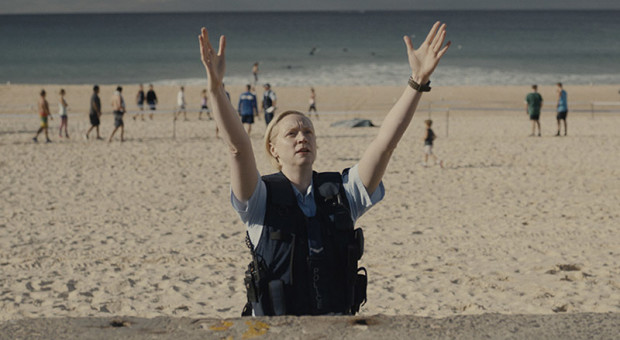
Hands up if you shouldn't be working this case!
Now, it’s worth interjecting at this stage with the observation that, if there’s one thing we learn from Top of the Lake, it’s that Australian police have some very sloppy procedures and conflict-of-interest regulations. Gwendoline Christie plays Miranda, with whom Robin is partnered in the investigation; Miranda is not only having an affair with her boss, but is also trying to have a baby by surrogacy with him. Worried that the foetus taken from the dead woman might be her own, Miranda has a bit of a barney at the office of the clinic that she patronised (matronised?). This strikes me as the sort of thing that might see a real police officer removed from a case, at the very least; but nothing at all is mentioned about it. Police officers having affairs with each other? I’m sure that happens. Police officers engaging surrogacy services? Likewise. Police officers investigating a case that straddles the boundary between legal and illegal surrogacy, at the behest of a commanding officer with whom they are trying to start a family by means of a legally-iffy surrogacy service? Is there no oversight here? At the same time, via Puss, the none-more-sleazy pimp played by David Dencik who has something to do with the illegal surrogacy racket and with whom Mary is besotted, the story is also very personal for Robin – just as was the story in the first series of Top of the Lake. Again: should she really be working on this case?

Maybe there is method in writer/ director Jane Campion’s plotting. There is a good point to be made about how our attempts to separate the private/ personal and the public/ political can only ever be partial, and that it’s often in women’s lives that we see the intersection most clearly. But there’s also a risk here of Robin becoming a slightly rough-at-the-edges Miss Marple: someone around whom Bad Things keep happening, and with whom you probably wouldn’t want to spend too long in a country house. Whether a third series of TotL would be possible without characters becoming mere ciphers for political points is unclear.

Admittedly, it’s a bit early to worry about the plausibility of a programme that might not ever be made; and the implausibilities of this series (or what one hopes, for the sake of effective policing in Australia, are implausibilities) ought not to detain us too long. For there are deep and troubling questions that the series raises.

15.8.17

Brexit, Fraud, and Law - update

A little over a year ago, I posted something about someone who had set up a crowdfunder campaign to bring a prosecution over Brexit.  I was not impressed.  I concluded by saying that the person behind it, one Marcus Ball, "should think very carefully about whether to keep his campaign going".  Of course, I'm not pompous enough to think that my opinion on this stuff counts for much, or that it'd make any contribution, or that Ball would even have read the post.  But if everyone with a blog allowed that to stop them, there'd be nothing on the internet.

I thought I'd have a look at what he's up to now.  There's still a website, but the clearest updates seem to be on the crowdfunder page.   Ball reached his initial target, so one might wonder what progress he'd made in his case.  The answer would seem to be... er... not a heck of a lot.  It appears that he contacted some lawyers, who told him in January that he didn't have a case, and he then went back to them in February with a 25 000-word document and had persuaded them that he did after all by March.  He is, though, unclear about what the legal objections were, and about how he overcame them.  One wonders why, if he is that much more competent than the lawyers he's hired at the expense of 6 000 donors, he needed them in the first place; but that's for another day.  Since then, he's written for his lawyers another pair of documents; one is 22 000 words long, and the other 10 000 words.  They must love him.  He's now asking for more money (some of which will fund a salary for him).  Hilariously, after the latest update on the BrexitJustice crowdunder, he adds a note:

11.8.17

Charlie Gard: An Ethical Analysis of a Legal non-Problem

(This is an extended version of a post that originally appeared at EJIL: Talk!)

For those with an internet connection and an interest in current affairs, the story of Charlie Gard been hard to avoid recently. A decent précis is available here; but it’s worth rehearsing.

Shortly after his birth, Charlie’s health began to deteriorate, and he was diagnosed with a terminal and incurable mitochondrial DNA depletion syndrome. By March 2017, Charlie needed artificial ventilation, and doctors at Great Ormond Street Children’s Hospital (GOSH) applied to the High Court for confirmation that removing that ventilation would be lawful, having judged that it was not in his best interests. This was contested by his parents, Chris Gard and Connie Yates; the High Court ruled in favour of GOSH. This was confirmed by the Supreme Court and the European Court of Human Rights. During all this time, Charlie remained ventilated.

In the High Court, Mr Justice Francis said that his decision was subject to revision should new evidence emerge favouring continued treatment; in July, Charlie’s parents returned to the High Court, claiming that Charlie might benefit from an experimental treatment being offered by Professor Michio Hirano of Columbia University. However, as proceedings advanced, it became clear that Hirano’s proposed treatment had never been used on patients like Charlie, that he had neither seen Charlie nor read his notes when he offered the treatment, and that he had a financial interest in that treatment. The position statement issued by GOSH on the 24th July barely hides the hospital’s legal team’s exasperation. On the 24th July, Charlie’s parents dropped their request for continued treatment. The details of Charlie’s palliative care were still disputed; his parents wanted it to be provided at home, with ventilation maintained for a few days. The High Court ruled against this on the 27th July. Charlie was moved to a hospice; his ventilator was removed, and he died on the 28th July, a few days before his first birthday.

The way this case has played out has not been pretty. Elements of the American media (this piece is one among many) and the political right wing used it to launch attacks on single-payer healthcare systems: Nigel Farage weighed in, complaining about the state taking away parental rights: From the left, Giles Fraser wrote that the case was being dealt with too rationally. None of these claims is justified, and many left-leaning people have been surprised to find themselves in agreement with Melanie Phillips on this matter.

Legally, the case was very straightforward.

3.8.17

Dunkirk, British, and the Germans

OK. So I went to see Dunkirk, because the reviews have been almost universally excellent, and because (a) it was endorsed by Nigel Farage, and (b) everyone pointed out that Farage had missed the point.  Farage missing the point is hardly news; but I wanted to see how he'd missed it.
 
(In what follows, there may be spoilers.  But since what actually happened at Dunkirk is a matter of record, and since there're no twists, I'm not too fussed about that.  I'll say a little about a couple of characters, but nothing that'll mar the film.)

Now, I can see why Brexiteers are getting all excited about the film.  Dunkirk is part of the British national story, and anything that tells a story about plucky British fortitude in the face of a threat from Ze Hun is going automatically to have them wanking themselves square then round again.  In other words, it matters little what the content of the film actually was: it'd've been coopted into the Brexit narrative somehow.  No contortion would have been too wild, because if you've got a fixed idea about that threat and a need for the British to retreat back to the safety of Blighty in the face of a threat from the Continent... well, you get the picture.

And I know I have an idée fixe about Brexit from the other side, too.  But this is my blog, so you'll have to lump it.

Anyway: back to the point I was going to make, which is that those Brexiteers have missed the point entirely.  Dunkirk's an avowedly anti-nationalist film.  And that's apparent from the first minute - from before any character appears on the screen.

The first thing we see is a one-sentence preamble telling us about how the British and French armies have been forced into retreat by "the enemy".  Note that Christopher Nolan doesn't talk about the Allied forces being forced into retreat by "the Germans" or "the German Army" or anything like that.  "The enemy" is in a way more menacing - but it's hard to see how it's anything other than a deliberate move so as not to name the Germans.  One might go a bit further, and infer that Nolan is indicating that Nazism was not German, or at least that there's a clear distinction to be made between what might have been done in the name of Germany and what was done in the name of the Third Reich.  There might be mileage in that - lots of contemporary Germanophiles thought so - but it's not a rabbit I want to chase here.  It's enough to point out that, in the most obvious way, Nolan has deliberately avoided making this a story about Germans and Englishmen.

Thus primed, I would encourage anyone who's not seen the film to count how many times the word "German" or its cognates is used.  I did: I think it's four.  In all cases (which appear over about 3 minutes in total), it's used as an accusation of untrustworthiness.  So far, so standard war-movie.  But it's always from the same character.   And that character is a terrified, paranoid, dangerous idiot, who is looking for someone to blame, and someone to shoot.

That is: the only person who makes a direct reference to Germans is someone with whom you wouldn't want to be in a confined space.  Other British characters are, by turns, doughty, brave, or - in a couple of cases - cowards.  In other words, they're exactly like most people.  They are not made saintly by dint of being British.

Now, there are atrocities committed by the enemy.  A ship that's clearly marked with a red cross is bombed.  I don't know if that happened in reality.  But even there, the bomb is from a machine.  We don't see the face of the pilot.  By and large, the enemy is unseen.  There is a brief moment when we see actual members of the Wehrmacht; but in that moment, when it would be very easy for them to kill a defenceless man, they don't.  They are not made evil by dint of being German.

In other words, the enemy can't be identified with a particular nation.  We know the origin of the enemy, but Nolan doesn't labour the point.  Nation doesn't really matter to the film he's made, which is about people in a situation behaving as people do.  He could have made appreciably the same film about any conflict, real or fictional.  Hell, he didn't even really need a conflict.  Except that, by making a film set in the second world war and not talking about nations or national character, he gives quite a clear message about nations and national character.

Quite clear, but not clear enough for some.  Farage doesn't really do nuance, and he can't really see beyond the nation.  It's little wonder he misunderstood what he saw.

3.5.17

MIFfed

I've got a bit of a dilemma.  It's a nice dilemma to have, and I know which way I'm leaning, but someone may tell me I'm being a fool.  They're wrong, but it's not quite as clear-cut as I thought it would be.

First things first: I love Manchester, and one of the things I love about Manchester is the Manchester International Festival.  It's two weeks of new and interesting art and culture, and even when a show doesn't work, as with Damon Albarn's Wonder.land a couple of years ago, it's still something that makes me proud to be a part of the city.

When tickets for MIF17 went on sale, I immediately went and spent an unholy amount on them.  I've crammed all the things I'm going to go to see into the second week of the Festival, because during the first week, I'll be in France.  This is at the invitation of one of my closest friends and her family; she lives in Australia now, so I only get to see her (and them) every couple of years.  So the final few days of June and the first few days of July are going to be packed, but great.  I'm really, really looking forward to them.

Except...

14.4.17

Law Changes and Slippery Slopes

(Cross-posted from the other place)

Apparently, there was a TV programme in Australia the other day in which a there was a discussion of assisted dying.  It got reported in The Guardian, largely on the basis that an 81-year-old audience member kept calling Margaret Somerville "darling" and then got mildly sweary.  I've only seen those clips from the programme that are linked in the Graun's report, so I'm not going to comment on the tone of the debate in particular.  Rather, I'm interested in one of the responses to the programme, from Xavier Symons, writing in The Conversation.

Symons takes the opportunity to unpick the idea of a slippery slope argument - in this case, the claim that allowing some forms of assisted dying will commit us to allowing... well, that's open-ended, but it's sufficient to say that it'd be terrible.  We'd want to avoid terrible things; therefore, the argument goes, we shouldn't allow any of it.  This is well-worn stuff in the seminar room, but it's a mode of argument that refuses to die.  Quite correctly, Symons points out that
there is a need for empirical evidence or sound inferential reasoning to support the claim that event B will necessarily (or probably) follow on from event A.  Without this evidence, the argument is invalid. I can’t just claim, for example, that the legalisation of medicinal marijuana leads to the legalisation of ice - I need to show some empirical or logical connection between the two.
So far, so standard.  (I'd say "unsound" rather than "invalid", because the validity of an argument doesn't depend on its evidence - or, at least, not in the same way; but that's a small matter.)  He then makes another move, which is a bit more interesting:
But (and it’s a big but) there is such a thing as a good and valid slippery slope argument.  A good slippery slope argument demonstrates a causal or probable relationship between event A and B, such that event B can legitimately be expected to occur if event A is allowed to occur. [...] There are, nevertheless, compelling empirical and logical slippery slope arguments available to defend more modest claims about the “normalisation” of assisted dying.
Is this correct?

14.2.17

"Denial" and Disinterest

Having taken myself off to see Denial the other night, I've been thinking about its portrayal of law - specifically, how it's done in the English courtroom.

The film that tells the story of Holocaust-denying Nazi third-rate historian David Irving's libel suit against Deborah Lipstadt.  His complaint was, basically, that she shouldn't have called him a Holocaust-denying Nazi third-rate historian, and that in doing so she was a big meanie, and booooo!  And, of course, as everyone knows, he lost.  This is why I can call him a Holocaust-denying Nazi third-rate historian here with impunity.  (Well, under the terms of the 2013 Defamation Act, I probably could anyway: the requirement for serious harm would mean that a blog with a readership as low as this would slip through the net.  But the point stands.  English law was satisfied that David Irving is a Holocaust-denying Nazi third-rate historian.)

One of the plot points - can one talk about a plot when one is aiming to represent reality?  I suppose you can: you can't distill a dispute that lasted years into a couple of hours without (a) deciding that there's a story worth telling there, (b) where the main parts of that story are to be found, and (c) weaving them into a plot - Anyway: one of the plot points concerns the way that English libel laws worked at the time.  These laws famously made it very hard to defend a libel action; the burden of proof would be on Lipstadt to show that she was correct, rather than on Irving to show her incorrect.  In a reversal of the normal order of legal proceedings, she'd have to prove her innocence; in effect, she'd have to show that the Holocaust happened.  Rachel Weisz' Lipstadt is clearly flummoxed by all this; and the film is plainly sympathetic to her confusion.  The English defamation laws were a mess.  (Whether they still are is for another post.)  Lipstadt is also baffled by the distinction between solicitors and barristers, meaning that it's a surprise to her that the lawyer she'd hired to take her case, and who'd be doing the donkey-work to put it together, would not be the lawyer who presented it in court.

I mean, you can see why someone not brought up on the system would think it weird.