There's a moment in the final episode of this second series of Jane Campion's Top of the Lake where Nicole Kidman's character Julia reminds Elizabeth Moss's character Robin, a policewoman and our protagonist, that she, Julia, is the 'real mother' of Mary (Alice Englert), the troubled and endangered young woman at the centre of the drama. Mary is adopted: Julia raised her, whereas Robin merely gestated her. An argument about exactly what it means to be a mother is not only important in the relationship between Robin and Julia: it is key to the main plot of the drama.
A body has been found washed up on a Sydney beach, and is discovered to be that of a Thai woman working in one of Sydney's legal brothels. The dead woman was pregnant when she died, but the baby is not genetically related to her; episode 2 ends with Robin's realisation that the dead woman was acting as a surrogate. What follows is a story that weaves together the rather murky worlds of the legalised sex trade and commercial surrogacy, which is illegal under New South Wales law.
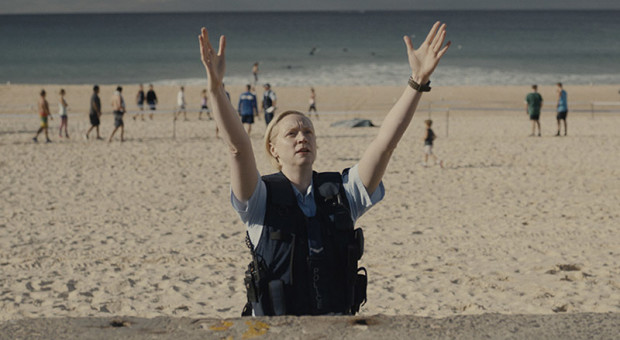 |
| Hands up if you shouldn't be working this case! |
Maybe there is method in writer/ director Jane Campion’s plotting. There is a good point to be made about how our attempts to separate the private/ personal and the public/ political can only ever be partial, and that it’s often in women’s lives that we see the intersection most clearly. But there’s also a risk here of Robin becoming a slightly rough-at-the-edges Miss Marple: someone around whom Bad Things keep happening, and with whom you probably wouldn’t want to spend too long in a country house. Whether a third series of TotL would be possible without characters becoming mere ciphers for political points is unclear.
Admittedly, it’s a bit early to worry about the plausibility of a programme that might not ever be made; and the implausibilities of this series (or what one hopes, for the sake of effective policing in Australia, are implausibilities) ought not to detain us too long. For there are deep and troubling questions that the series raises.

