Showing posts with label Reviews. Show all posts

11.8.22

The Academic Merit of "What I Did on my Holidays"

There are no frequent or regular readers of this blog, because it is updated so infrequently and irregularly.  It takes a lot to get me to add anything.  Quite often, a longish thread on Twitter is as close as I get to blogging these days.  But sometimes, things need a bit more working-out.  Things such as this paper, "I am not Alone – We are all Alone: Using Masturbation as an Ethnographic Method in Research on Shota Subculture in Japan" by Karl Andersson, published in the journal Qualitative Research, which has attracted a fair bit of attention on social media in the past few days on the basis of a tweet from the Tory MP and culture warrior Neil O'Brien - a tweet that led a number of equal-but-opposite culture warriors to decide that since he'd condemned it, it must be worth defending (and then, at least sometimes, walking it back, as here and here; others have simply deleted their tweets in defence, presumably in the hope that we'll forget them.)

But Twitter is a notoriously more-heat-than-light sort of place, and so I decided to read the paper for myself, and to put myself in something like the position of a peer-reviewer.  Is the paper actually any good?  Does it have academic merit?

I don't think it does, and I'll explain why in a moment.  But first, a few things should be noted.

10.10.17

"Top of the Lake" may Sink as a Procedural, but Look Beneath the Surface

A couple of weeks ago, BioNews invited me to review Top of the Lake; this is the version I submitted there, free - for better or worse - of editorial cuts.

There's a moment in the final episode of this second series of Jane Campion's Top of the Lake where Nicole Kidman's character Julia reminds Elizabeth Moss's character Robin, a policewoman and our protagonist, that she, Julia, is the 'real mother' of Mary (Alice Englert), the troubled and endangered young woman at the centre of the drama. Mary is adopted: Julia raised her, whereas Robin merely gestated her. An argument about exactly what it means to be a mother is not only important in the relationship between Robin and Julia: it is key to the main plot of the drama.

A body has been found washed up on a Sydney beach, and is discovered to be that of a Thai woman working in one of Sydney's legal brothels. The dead woman was pregnant when she died, but the baby is not genetically related to her; episode 2 ends with Robin's realisation that the dead woman was acting as a surrogate. What follows is a story that weaves together the rather murky worlds of the legalised sex trade and commercial surrogacy, which is illegal under New South Wales law.

Hands up if you shouldn't be working this case!
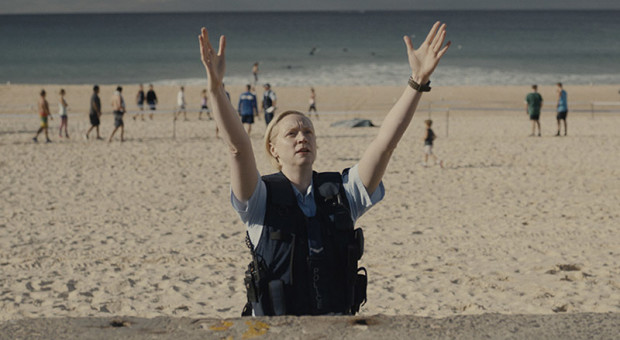
Now, it’s worth interjecting at this stage with the observation that, if there’s one thing we learn from Top of the Lake, it’s that Australian police have some very sloppy procedures and conflict-of-interest regulations. Gwendoline Christie plays Miranda, with whom Robin is partnered in the investigation; Miranda is not only having an affair with her boss, but is also trying to have a baby by surrogacy with him. Worried that the foetus taken from the dead woman might be her own, Miranda has a bit of a barney at the office of the clinic that she patronised (matronised?). This strikes me as the sort of thing that might see a real police officer removed from a case, at the very least; but nothing at all is mentioned about it. Police officers having affairs with each other? I’m sure that happens. Police officers engaging surrogacy services? Likewise. Police officers investigating a case that straddles the boundary between legal and illegal surrogacy, at the behest of a commanding officer with whom they are trying to start a family by means of a legally-iffy surrogacy service? Is there no oversight here? At the same time, via Puss, the none-more-sleazy pimp played by David Dencik who has something to do with the illegal surrogacy racket and with whom Mary is besotted, the story is also very personal for Robin – just as was the story in the first series of Top of the Lake. Again: should she really be working on this case?

Maybe there is method in writer/ director Jane Campion’s plotting. There is a good point to be made about how our attempts to separate the private/ personal and the public/ political can only ever be partial, and that it’s often in women’s lives that we see the intersection most clearly. But there’s also a risk here of Robin becoming a slightly rough-at-the-edges Miss Marple: someone around whom Bad Things keep happening, and with whom you probably wouldn’t want to spend too long in a country house. Whether a third series of TotL would be possible without characters becoming mere ciphers for political points is unclear.

Admittedly, it’s a bit early to worry about the plausibility of a programme that might not ever be made; and the implausibilities of this series (or what one hopes, for the sake of effective policing in Australia, are implausibilities) ought not to detain us too long. For there are deep and troubling questions that the series raises.

3.8.17

Dunkirk, British, and the Germans

OK. So I went to see Dunkirk, because the reviews have been almost universally excellent, and because (a) it was endorsed by Nigel Farage, and (b) everyone pointed out that Farage had missed the point.  Farage missing the point is hardly news; but I wanted to see how he'd missed it.
 
(In what follows, there may be spoilers.  But since what actually happened at Dunkirk is a matter of record, and since there're no twists, I'm not too fussed about that.  I'll say a little about a couple of characters, but nothing that'll mar the film.)

Now, I can see why Brexiteers are getting all excited about the film.  Dunkirk is part of the British national story, and anything that tells a story about plucky British fortitude in the face of a threat from Ze Hun is going automatically to have them wanking themselves square then round again.  In other words, it matters little what the content of the film actually was: it'd've been coopted into the Brexit narrative somehow.  No contortion would have been too wild, because if you've got a fixed idea about that threat and a need for the British to retreat back to the safety of Blighty in the face of a threat from the Continent... well, you get the picture.

And I know I have an idée fixe about Brexit from the other side, too.  But this is my blog, so you'll have to lump it.

Anyway: back to the point I was going to make, which is that those Brexiteers have missed the point entirely.  Dunkirk's an avowedly anti-nationalist film.  And that's apparent from the first minute - from before any character appears on the screen.

The first thing we see is a one-sentence preamble telling us about how the British and French armies have been forced into retreat by "the enemy".  Note that Christopher Nolan doesn't talk about the Allied forces being forced into retreat by "the Germans" or "the German Army" or anything like that.  "The enemy" is in a way more menacing - but it's hard to see how it's anything other than a deliberate move so as not to name the Germans.  One might go a bit further, and infer that Nolan is indicating that Nazism was not German, or at least that there's a clear distinction to be made between what might have been done in the name of Germany and what was done in the name of the Third Reich.  There might be mileage in that - lots of contemporary Germanophiles thought so - but it's not a rabbit I want to chase here.  It's enough to point out that, in the most obvious way, Nolan has deliberately avoided making this a story about Germans and Englishmen.

Thus primed, I would encourage anyone who's not seen the film to count how many times the word "German" or its cognates is used.  I did: I think it's four.  In all cases (which appear over about 3 minutes in total), it's used as an accusation of untrustworthiness.  So far, so standard war-movie.  But it's always from the same character.   And that character is a terrified, paranoid, dangerous idiot, who is looking for someone to blame, and someone to shoot.

That is: the only person who makes a direct reference to Germans is someone with whom you wouldn't want to be in a confined space.  Other British characters are, by turns, doughty, brave, or - in a couple of cases - cowards.  In other words, they're exactly like most people.  They are not made saintly by dint of being British.

Now, there are atrocities committed by the enemy.  A ship that's clearly marked with a red cross is bombed.  I don't know if that happened in reality.  But even there, the bomb is from a machine.  We don't see the face of the pilot.  By and large, the enemy is unseen.  There is a brief moment when we see actual members of the Wehrmacht; but in that moment, when it would be very easy for them to kill a defenceless man, they don't.  They are not made evil by dint of being German.

In other words, the enemy can't be identified with a particular nation.  We know the origin of the enemy, but Nolan doesn't labour the point.  Nation doesn't really matter to the film he's made, which is about people in a situation behaving as people do.  He could have made appreciably the same film about any conflict, real or fictional.  Hell, he didn't even really need a conflict.  Except that, by making a film set in the second world war and not talking about nations or national character, he gives quite a clear message about nations and national character.

Quite clear, but not clear enough for some.  Farage doesn't really do nuance, and he can't really see beyond the nation.  It's little wonder he misunderstood what he saw.

14.2.17

"Denial" and Disinterest

Having taken myself off to see Denial the other night, I've been thinking about its portrayal of law - specifically, how it's done in the English courtroom.

The film that tells the story of Holocaust-denying Nazi third-rate historian David Irving's libel suit against Deborah Lipstadt.  His complaint was, basically, that she shouldn't have called him a Holocaust-denying Nazi third-rate historian, and that in doing so she was a big meanie, and booooo!  And, of course, as everyone knows, he lost.  This is why I can call him a Holocaust-denying Nazi third-rate historian here with impunity.  (Well, under the terms of the 2013 Defamation Act, I probably could anyway: the requirement for serious harm would mean that a blog with a readership as low as this would slip through the net.  But the point stands.  English law was satisfied that David Irving is a Holocaust-denying Nazi third-rate historian.)

One of the plot points - can one talk about a plot when one is aiming to represent reality?  I suppose you can: you can't distill a dispute that lasted years into a couple of hours without (a) deciding that there's a story worth telling there, (b) where the main parts of that story are to be found, and (c) weaving them into a plot - Anyway: one of the plot points concerns the way that English libel laws worked at the time.  These laws famously made it very hard to defend a libel action; the burden of proof would be on Lipstadt to show that she was correct, rather than on Irving to show her incorrect.  In a reversal of the normal order of legal proceedings, she'd have to prove her innocence; in effect, she'd have to show that the Holocaust happened.  Rachel Weisz' Lipstadt is clearly flummoxed by all this; and the film is plainly sympathetic to her confusion.  The English defamation laws were a mess.  (Whether they still are is for another post.)  Lipstadt is also baffled by the distinction between solicitors and barristers, meaning that it's a surprise to her that the lawyer she'd hired to take her case, and who'd be doing the donkey-work to put it together, would not be the lawyer who presented it in court.

I mean, you can see why someone not brought up on the system would think it weird.

13.9.16

Weeping Songs

It's not about Arthur.  Keep telling yourself that.  Nick Cave has said himself that only one song on Skeleton Tree was written after the death of his son (although they were all recorded in its wake), and he's not said what that one song is.  So the album isn't about Arthur.  Well, most of it isn't.  Well, it wasn't intended to be when it was written.  So let's put Arthur to one side.  We shouldn't make it about him anyway.  That'd get in the way of writing an honest review.  I mean: what if the album's rubbish?  What kind of heartless bastard would you have to be to slate it in that case?  Who'd slag off Kindertotenleider?

So let's treat Skeleton Tree as just another stage in the evolution of Nick Cave (and sometimes the Bad Seeds).  There was the old-time Old Testamential Nick Cave of, say, "Tupelo"; there was the gleeful Grand Guignol of "Stagger Lee"; the sleaze of Dig, Lazarus, Dig! and the Grinderman side-project (which might as well be a Bad Seeds spin off); the introspection of White Lunar (another Seeds spin-off in all but name) and Push the Sky Away.  This is just another layer accreted.  Front Row on Radio 4 talked about this album as a sequel to Sky, and it does feel something like that - more of a development than a sequel, but something in the same vein.  But there's a difference; a big difference.

Before now, at his darkest, Nick Cave offered a way out.  Either there was a knowing wink to the camera: think of the videos to "The Weeping Song", or "Fifteen Feet of Pure White Snow", or there was a blast of noise that pulled you through to the other side, as in this live version of "Jubilee Street".  And in Skeleton Tree?

3.5.16

Repeating a Success is Still Repetition

Review: Nerissimo
Teho Teardo & Blixa Bargeld (Specula)
.....
"Hope."

That single word constitutes the first refrain of "DBX 2", the second track on Teho Teardo and Blixa Bargeld's second full album, Nerissimo.  The second time we hear the refrain, it's changed.  "Hope," it now goes, "Should be/ A controlled substance".

One shouldn't read anything much into the lyrics to pop songs.  All the same, it sounds like it's asking for trouble for people who'd been waiting expectantly for this followup to 2013's Still Smiling.  They - oh, all right: we - would have had no small amount of hope invested in the project; Still Smiling is a great album, and between that and this, Bargeld had overseen a brilliant return to form for Einstürzende Neubauten, in the form of Lament.  So there was every reason to be hopeful.  Yet, one can be too hopeful; as the lyric suggests, there might be times when hope ought to be kept in check.  Hope might be the kind of thing upon which we oughtn't to get too dependent.

After all, getting the Lament project together, and then touring it alongside a sarcastically-titled "Greatest Hits" set could easily have meant simply that there wasn't really time to get the new album to succeed as well as it might.  Faced with that kind of pressure of work, it's equally possible that a person would fall back on tried-and-tested formulae rather than doing anything all that new; and any innovations attempted, by the same token, may not have the fullest realisation.  On reflection, it's this more downbeat assessment that is the more appropriate when evaluating Nerissimo.

The basic problem is that, although there are elements that build on the last album - there's a use of steel guitars gives the album an almost country-rock undertone ("Animelle" having hints of REM's "Airportman", for example) - the bulk of the record is rather derivative.  Much of it relies on extensive recycling of material heard on Still Smiling: "The Beast" clearly fits the same mould as "Buntmetalldiebe";  "DBX 2" is a close cousin of "What If?".

Bargeld has been happily ripping off his own back catalogue for almost as long as he's had one to rip off.  Hence we shouldn't really be surprised to find that it's not only the last Teardo and Bargeld collaboration that is pillaged/ revisited (delete as appropriate), but Bargeld's contributions to the other bands with which he's been associated.  The lyrics to the titular opening track hark back to "Sabrina", the opening track of Neubauten's Silence is Sexy; "Ich Bin Dabei" has - alongside another hint of "What If?" - a clear echo of the Bad Seeds' "Stranger than Kindness".  He's even gone so far as to include what is pretty much the same song on two albums in the past: "The Garden" is more or less the same track that appeared three years earlier as "Salamandrina".  The pattern, of course, is itself copied from musicians through the ages: there's any number of composers from the classical tradition who quote themselves (and others) freely.  Yet it's one thing to be expected to churn out yet another Mass or cantata for an Esterhazy on a weekly basis - I'm guessing here, but I wouldn't be surprised to discover that a significant portion of what we take to be the musical canon either started out as hack-work, or informed hack-work shortly after its composition - but it's quite another to approach album-making in that way; the context is very different.  Not the least of the differences is that the album is released on Teardo's own Specula label, so there should have been no pressure on that front.  Hence it is perhaps pushing things a little to include two versions of the title track - once in English, and once in Italian - to top and tail what is anyway only a nine-track album.  It's one thing to want to return to a theme or idea to work it out as fully as possible; but I'm not sure that there's really that much of a new angle being taken here.  For what it's worth, the Italian version is preferable, but that's because I don't speak Italian; Italophones may prefer the English.

In passing, there's the odd moment when Bargeld's voice seems to be feeling the strain - "The Empty Boat" really could have done with another take.

Lest this sound like an attack on the album, it's really not meant to be.  Is the album any good?  Yes: it certainly is - with the possible exception of "Ulgae", which... um... well, you know that Simpsons Tree-House of Horror episode in which creates a whole civilisation in a petri-dish?  Yeah.  Let's leave it at that.  But if you ignore that, and the double inclusion of the title track, you're left with a long EP as much as a short album.  A good one, for sure, but - well, is it enough, and good enough?

The nagging suspicion is that if Nerissimo is a good album, that's because Still Smiling is a very good album, and Teardo and Bargeld have taken some of its component parts, spray-painted them, and released them again.  Control your hope.

23.11.15

Review: Carl Schneider and Censorship

The Censor’s Hand: The Misregulation of Human-Subject Research
Carl E Schneider
The MIT Press

(NB: I was commissioned to review this book for Pacific Standard in September; what's published here is the first draft, from early October.  After some suggestions from the editor, I submitted a revised second draft a couple of days later.  Neither draft has been published there yet, and I've no idea if and when that will change.  If anything does appear there, I'll provide a link.)

Not so long ago, Stephen Pinker provoked the ire of many bioethicists by appearing to launch an attack on institutional ethical review boards (IRBs).  Accusing them of hindering important work in science, he wrote that they should “get out of the way”.  Bioethicists responded by pointing out that there is a history of researchers behaving abominably – the go-to example in recent years being the Tuskegee syphilis study, in which black men were deliberately left untreated so that the natural course of the disease could be studied.  Ethical review, the bioethicists’ response goes, will not guarantee that nothing bad will ever happen; but it does reduce the chance.

Yet Pinker’s broad claim is not without support from within the bioethics community.  Thoughtful commentators have been looking at the institutional review board system for some while now, and arguing that it needs significant reform.  Could it be, some have wondered, that “bioethics” has become an end in itself, claiming an authority with which even many bioethicists are uncomfortable?  And if, then, there is a decent case for reform, how far should it go?  Some think that the system needs re-tuning; some think that it needs something approaching a rebuild.  And some think that a rebuild is too conservative: that the system is, and cannot but be, so broken that the only option is to get rid of it all together.  In this camp, we find Carl Schneider.  The Censor’s Hand aims to present the case not against IRBs as they are, but against IRBs tout court.