Showing posts with label Politics. Show all posts

18.8.20

So What Happens Now?

 Gavin Williamson is a sorry excu...  No, wait.  I'll start again.

Gavin Williamson is sorry.  He's been wandering around the various news studios leaving great big apologies right in the middle of the floor where everyone can see them.  He's very sorry for the A-Level debacle.  It's tempting to feel sympathetic for a moment - after all, the coronovirus shutdown is unprecedented, and so there'll've been difficulties.  But the moment of sympathy is very short, because although the hope of running the summer exams as normal might have been on the table back at the beginning of March, it should quickly have become apparent that that was not going to happen.
And even if in April the government had been clinging to that hope, they ought to have realised that there was a good chance that there'd have to be something else up their sleeves as a fallback.
And then after the debacle in Scotland last week...  Oh, you get the idea.
Nobody really minds things being up in the air at the moment.  Nobody really minds plans being undermined by reality.  What we do mind is governments that don't seem to have thought more than two days ahead.  A plan that can't come to fruition is better than no plan at all.
But, anyway.  A-Level students have something approximating a result, and hopefully most of them will get into university, which is all peachy... unless you're a university.
Just off the top of my head, let me try to explain some of the problems we're going to have.

2.8.20

Tracing Apps: Precaution and Paranoia


It's a little over a year since I last blogged anything.  Partly that's because I had other things on my mind, and nothing struck me as being the kind of topic about which I had much to say.  And then Covid-19 came along, and I still didn't have anything to say.

Could prior exposure to common cold viruses affect the severity of ...
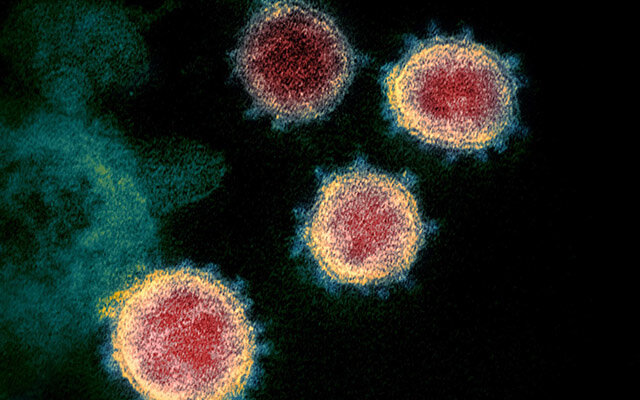
Gratuitous virus image!  Yay!
I think that a lot of people don't have much to say about it; but that doesn't seem to have stopped them saying it anyway.  There's been a lot of nonsense.  And there's also been a lot of stuff that isn't nonsense, but that is nonetheless trivial, as people find an excuse to make their rather quotidian thoughts about consent or resource allocation or whatever relevant by sticking "... in the Time of Coronavirus" at the end of the title and bunging it off to a journal.  Hey-ho.  The REF's coming.  What do you expect?

The upshot is that I've been ignoring most of the CV-19 stuff; but every now and again, something catches my eye - such as this piece by Deena Davis on the Hastings Center blog: "Before We Turn to Digital Contact Tracing for Covid, Remember Surveillance in the Sixties", the conclusion of which is that "for me, digital contact tracing [through phone apps] is a bridge too far".

Why would this be?  The concern articulated has to do with the misuse of data.  Once you're being traced, who knows what'll happen to the data generated?  There are precedents for things happening with it that one might not welcome:
Do you remember when we discovered that Uber’s passenger app not only traced you to your destination, but continued to trace where you went after you exited the car?
And so the worry is that by installing a tracing app, one would potentially be handing over vast amounts of information to the government, which might use it for sinister ends.  For example, it might allow information to be gathered about immigration lawyers having met clients - presumably, not something that one would want to see.  Correspondingly, we might see other instances of governments prying into personal lives.  And this is at the root of the reason not to install the app.
In order to place such an app on my phone I would have to believe at least the following things: that the promised anonymity would be respected, that the government would not get hold of it, and that it would not be used to trace contacts for other reasons, e.g., to discover an immigration lawyer’s clients.
[W]e would need important safeguards against mission creep, whereby the surveillance app did not de-activate just because the pandemic was over. Perhaps the government discovers a new use for it; perhaps we kind of get used to it, the way we are used to the idea that our E-ZPass keeps a record of every toll booth we have gone through and our grocery store loyalty card keeps a record of the foods we buy.  [Ryan] Calo [has] noted that “clear, explicit rules are critical,” but what point are rules if the government clandestinely subverts them?
Well, OK.  But it's one thing to raise concerns about what a government might do nefariously with data gathered through a tracing app - quite another to take those concerns as settling matters.  For one thing, we have to ask ourselves whether governments actually would do that.  Perhaps they would.  Perhaps not.  It's notable that Davis doesn't really go beyond the "But what if..." stage of argument.  But that's a really cheap move.  We need to know more about the likelihood of this or that outcome.  ("But what if my writing this blog inspires a white supremacist murder?"  Well, I suppose there is a non-zero chance that it could, somehow.  But it's not likely.  It's not a reason not to write it.  The example is hyperbolic, but I hope it gets the point across.)

Let's stick with the immigration lawyer example.  It strikes me that there's a number of problems with this.  The first is that people who are concerned about deportation are likely to be among those least likely to download any kind of track-and-trace app to begin with.  And so - assuming I've understood the technology correctly and it'll be required for two phones to have it installed and active for it to work - there won't be a particular concern there.  Even if I've misunderstood the technology, anyone who is particularly worried would be able simply to turn their phone off for a bit, or leave it at home, or something like that.  This does undermine the efficacy of the app, for sure - and I'll come back to that point in a moment.  (The qualifier would have to do with instances in which apps are installed automatically, like U2 albums.  But if that's the case, there's nothing special about CV-19 apps, because presumably governments could install such apps anyway, and much more surreptitiously.)

In the meantime, it's also worth noting that there are rules about legal privilege that militate against the government making use of data gathered from such an app.  And while I'm not sure how powerful this point is - it's not obvious that there'd be a way to distinguish reliably between a lawyer and a client meeting in the office (which would be privileged) and their meeting in Starbuck's half an hour later (which wouldn't), the principle applies; and, of course, it people are bumping into each other in the coffee shop, then this is a "civilian" interaction anyway, so whether people are immigrants or lawyers would be neither here nor there.  They could easily be just people who happened to be close by at a given point.

"Ah, yes," the response might go, "It's true that the government would be in trouble if it subverted the rules on legal privilege; but so what?  By then it's too late.  And as Davis says, what point are rules if the government subverts them?"  And, superficially, this has a certain attraction as an argument - except for two considerations.  First, it militates against having rules on anything: if you've decided that they won't stop nefarious behaviour, you might as well not have them; and if you don't have the rules, then there's nothing about which to complain.  sequitur, second, that though the rules might not stop people determined to be bastards, their being there does give you a way to resist that bastardy.  That's an important point of principle.  So, for example, if you're an immigrant who's facing deportation because of the rule-breaking way an app was used, you'd have grounds for that deportation decision to be overturned or suspended, because there was (in effect) a due process violation.  Now, admittedly, it might be that when push comes to shove, this makes no practical difference.  But, as indicated, the point of principle would stand, and at the very least it would improve the prospects of other immigrants in a similar situation.

But a point that's more important than any of that is, I think, this: that the reason for having the app is important.  Davis doesn't say much about that, concentrating instead on the reasons to be suspicious of it.  But the examples she offers are examples of institutions using data for what we can take to be bad reasons.  It is prima facie undesirable for Uber to scrape data for commercial reasons.  It is prima facie undesirable for governments to try to sidestep legal norms when it comes to things like immigration (or anything else).  There does not seem to be a particularly compelling, or even good - by which I mean morally defensible - reason for either of those things to happen.

An app for exposure to CV-19 is different.  The underlying reason for that seems to be prima facie decent.  So even if there are reasons con as well, matters are different from how they appear in the examples offered.  We can't make sense of the desirability or otherwise of installing the app unless we give a full account of the reasons pro and con.  It might even be that we find the reasons for a CV-19 app unconvincing all told.  Nevertheless, there is a qualitative difference between it and the other examples Davis offers, precisely because there is a weighty moral reason for a CV-19 app that there isn't in other cases.

And this is where I go back to the point about lawyers switching off their phones for a while.  There is a reason not to.  But maybe, if the government is untrustworthy enough, there is a reason to do that.

If there are no particularly good reasons to install the app, then don't install it.  If the positive reasons not to are great, then don't install it.  But slightly vague appeals to the risk of state surveillance don't seem to me to carry much weight.


13.11.18

Academics Anonymous

The launch of a new academic journal doesn't normally attract much attention; but the launch of a journal that promises anonymity to authors who need protection, who who feel that they need it, because of the nature of their ideas has caused a bit of a stir.

I don't know most of the people involved; but I know some, and others are friends of friends.  No particular alarm bells are ringing.  (Francesca Minerva's name has been mentioned.  I'm not bessie mates with her, but I do know her professionally; she's whip-smart, as well as being a nice person.  On the other hand, she does have form when it comes to pressing for anonymity, and I articulated my concerns about her position at the other place... crikey.  Five years ago.)

I also know, and know of, a fair number of people who have faced appalling treatment for holding certain intellectual positions or advancing particular arguments.  Sometimes, those are positions and arguments that appear in peer-reviewed journals; I would be curious to know how much of the treatment comes from people who've read carefully the peer-reviewed papers about which they're protesting, as opposed to people who are outraged by proxy.  (Francesca wrote what I jokingly call The Paper Of Which We Do Not Speak and faced all kinds of abuse for it - much of it, I think, by proxy, after the Daily Mail and then Glenn Beck got hold of it.)  Sometimes they aren't positions articulated in journals; several academics that I know and respect have found themselves attacked for what seems to me to be the crime of being insufficiently woke on questions of gender and the law.

Either way, more often than not, as far as I can see, this treatment has come not from universities, but from civil - no: uncivil - society.  Universities have, at least sometimes, done the right thing in sticking up for academics.  This matters, because people receiving abuse for their positions are obviously people who have not been silenced and who - presumably - count as evidence against the case for anonymity.  Still, I can see how people might think that anonymity would be desirable, at least sometimes.  And there are anecdotes about people's academic careers suffering because of their intellectual commitments.

And yet I'm unconvinced by this journal, and for a number of reasons.


16.3.18

The Public Realm and the Public Good

This is a pair of Supertrees.  They're in Singapore, at a place called Supertree Grove, which is part of the Gardens by the Bay; and they've made me think about one of the ways we do public space in the UK.  But I need to set things up a bit first.

I'd not expected to like Singapore; or, more strongly, I'd expected not to like it.  It's got a reputation for being a bit preppy, a bit too hyper-capitalist, a bit authoritarian, a bit... well, a bit neat.  But I went there for a conference in 2010, and I loved it.  I got a sense that the reputation was accurate to an extent, but only to an extent.  For sure, it's authoritarian, and it does a good show of being very ordered.  But it's also completely bonkers.  Not that I can put my finger on exactly why, of course.  But it is.  If you've been, you'll know what I mean.  If you don't... you should go.  (Forced to elaborate, I'd say something about the juxtaposition of the hyper-modern and sleek with the rather more ramshackle; about the way that finance capital rubs shoulders with food hawker stalls; about the way that Taoist temples in Chinatown and Hindu shrines in Little India are only a few minutes walk from gleaming skyscrapers.  Bonkers, for sure - but also beautiful.)

Anyway: I got the chance to go back there at the beginning of this month, on a work thing.  I made a show of reluctance, but I did want to go back.  And while there, I wanted to go to see Supertree Grove, which wasn't there last time.  These "trees" are a bit hard to describe.  They're big.  They're a funny shape.  They look like something from the cover of a sci-fi paperback.  Part of their function is to be a component of exhaust and aircon system for the biomes.  But they're obviously much more than that; another part of their function is aesthetic.  They're home to thousands of plants, and are artworks in their own right.  They fit perfectly into the bonkers-but-beautiful theme.

As it goes dark, they're illuminated; and twice an evening, there's a 15-minute son et lumière show.  It's cheesy as hell, but there's no shame in giving in to that every now and again.  And this is the bit that made me think about public space in the UK and in Singapore.  Though you have to pay to go into the biomes, the rest of Gardens by the Bay is free - including the son et lumière.  Not only that; there's no branding.  Were it in the UK, I'm pretty sure that there'd be signs all over the place trumpeting that the show was brought to you in conjunction with SuperBank MegaCorp, and there'd be an announcement to that effect as well (as if SuperBank MegaCorp had any relevance at all to the lives of the people watching).  And in hyper-capitalist Singapore?  Nothing like that.  It's just there.  A good thing, provided pro bono publico - which may be what makes the cheesiness of it OK.

9.1.18

A Limited Defence of Toby Young

(Originally posted as a two-parter at the other place, here and here.  Admittedly, events have moved on a bit since yesterday, but the point about eugenics stands.)

The response to Toby Young's appointment to the new Office for Students has covered the whole range from "He's not the best person for the job" to "He's the worst person for the job".  Some of the reasons offered have to do with unsavoury comments about women; some have to do with his general lack of qualification.  Writing in The Times, Janice Turner is - I think - balanced in her assessment of his qualities, but still finds him to be (to say the least) wanting.  But the thing that's of interest to me here, on what is a bioethics-related blog, is one of the other sources of controversy: his public support for (a kind of) eugenics.  The mere fact that he could be associated with eugenics has had some people in paroxysms.  Taken more or less at random here's a tweet from Vince Cable:
Note that "backs eugenics" is offered as being a reason in itself to object to Young's appointment.  Cable is not, by a long way, the only person to make this sort of comment.

Is it justified, though?  Well, the article that's generated the ire is this one, called "The Fall of the Meritocracy", published in 2015 in Quadrant.  It's a long piece, and the eugenics bit only comes about 80% of the way through, and for that reason I'll only home in on a few details.  But it is worth looking in a bit more depth at some of those details.  I think that what he's arguing is, in many ways, fairly unremarkable.  It's mistaken in important ways, too; I'll come to those in the next post.  But whatever problems there are with the piece do not flow from the use of the "E-word".  And so, to the greatest extent possible, I'll try to talk about it without mentioning eugenics.

10.10.17

"Top of the Lake" may Sink as a Procedural, but Look Beneath the Surface

A couple of weeks ago, BioNews invited me to review Top of the Lake; this is the version I submitted there, free - for better or worse - of editorial cuts.

There's a moment in the final episode of this second series of Jane Campion's Top of the Lake where Nicole Kidman's character Julia reminds Elizabeth Moss's character Robin, a policewoman and our protagonist, that she, Julia, is the 'real mother' of Mary (Alice Englert), the troubled and endangered young woman at the centre of the drama. Mary is adopted: Julia raised her, whereas Robin merely gestated her. An argument about exactly what it means to be a mother is not only important in the relationship between Robin and Julia: it is key to the main plot of the drama.

A body has been found washed up on a Sydney beach, and is discovered to be that of a Thai woman working in one of Sydney's legal brothels. The dead woman was pregnant when she died, but the baby is not genetically related to her; episode 2 ends with Robin's realisation that the dead woman was acting as a surrogate. What follows is a story that weaves together the rather murky worlds of the legalised sex trade and commercial surrogacy, which is illegal under New South Wales law.

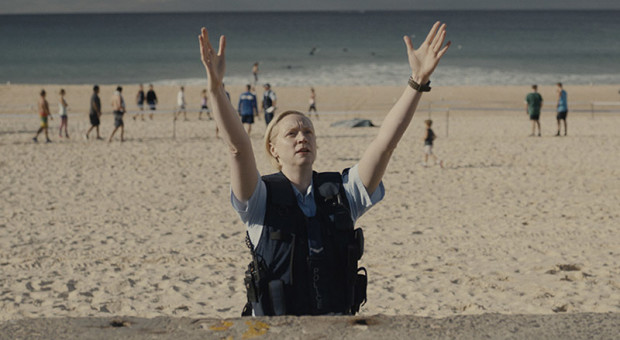
Hands up if you shouldn't be working this case!
Now, it’s worth interjecting at this stage with the observation that, if there’s one thing we learn from Top of the Lake, it’s that Australian police have some very sloppy procedures and conflict-of-interest regulations. Gwendoline Christie plays Miranda, with whom Robin is partnered in the investigation; Miranda is not only having an affair with her boss, but is also trying to have a baby by surrogacy with him. Worried that the foetus taken from the dead woman might be her own, Miranda has a bit of a barney at the office of the clinic that she patronised (matronised?). This strikes me as the sort of thing that might see a real police officer removed from a case, at the very least; but nothing at all is mentioned about it. Police officers having affairs with each other? I’m sure that happens. Police officers engaging surrogacy services? Likewise. Police officers investigating a case that straddles the boundary between legal and illegal surrogacy, at the behest of a commanding officer with whom they are trying to start a family by means of a legally-iffy surrogacy service? Is there no oversight here? At the same time, via Puss, the none-more-sleazy pimp played by David Dencik who has something to do with the illegal surrogacy racket and with whom Mary is besotted, the story is also very personal for Robin – just as was the story in the first series of Top of the Lake. Again: should she really be working on this case?

Maybe there is method in writer/ director Jane Campion’s plotting. There is a good point to be made about how our attempts to separate the private/ personal and the public/ political can only ever be partial, and that it’s often in women’s lives that we see the intersection most clearly. But there’s also a risk here of Robin becoming a slightly rough-at-the-edges Miss Marple: someone around whom Bad Things keep happening, and with whom you probably wouldn’t want to spend too long in a country house. Whether a third series of TotL would be possible without characters becoming mere ciphers for political points is unclear.

Admittedly, it’s a bit early to worry about the plausibility of a programme that might not ever be made; and the implausibilities of this series (or what one hopes, for the sake of effective policing in Australia, are implausibilities) ought not to detain us too long. For there are deep and troubling questions that the series raises.

15.8.17

Brexit, Fraud, and Law - update

A little over a year ago, I posted something about someone who had set up a crowdfunder campaign to bring a prosecution over Brexit.  I was not impressed.  I concluded by saying that the person behind it, one Marcus Ball, "should think very carefully about whether to keep his campaign going".  Of course, I'm not pompous enough to think that my opinion on this stuff counts for much, or that it'd make any contribution, or that Ball would even have read the post.  But if everyone with a blog allowed that to stop them, there'd be nothing on the internet.

I thought I'd have a look at what he's up to now.  There's still a website, but the clearest updates seem to be on the crowdfunder page.   Ball reached his initial target, so one might wonder what progress he'd made in his case.  The answer would seem to be... er... not a heck of a lot.  It appears that he contacted some lawyers, who told him in January that he didn't have a case, and he then went back to them in February with a 25 000-word document and had persuaded them that he did after all by March.  He is, though, unclear about what the legal objections were, and about how he overcame them.  One wonders why, if he is that much more competent than the lawyers he's hired at the expense of 6 000 donors, he needed them in the first place; but that's for another day.  Since then, he's written for his lawyers another pair of documents; one is 22 000 words long, and the other 10 000 words.  They must love him.  He's now asking for more money (some of which will fund a salary for him).  Hilariously, after the latest update on the BrexitJustice crowdunder, he adds a note:

11.8.17

Charlie Gard: An Ethical Analysis of a Legal non-Problem

(This is an extended version of a post that originally appeared at EJIL: Talk!)

For those with an internet connection and an interest in current affairs, the story of Charlie Gard been hard to avoid recently. A decent précis is available here; but it’s worth rehearsing.

Shortly after his birth, Charlie’s health began to deteriorate, and he was diagnosed with a terminal and incurable mitochondrial DNA depletion syndrome. By March 2017, Charlie needed artificial ventilation, and doctors at Great Ormond Street Children’s Hospital (GOSH) applied to the High Court for confirmation that removing that ventilation would be lawful, having judged that it was not in his best interests. This was contested by his parents, Chris Gard and Connie Yates; the High Court ruled in favour of GOSH. This was confirmed by the Supreme Court and the European Court of Human Rights. During all this time, Charlie remained ventilated.

In the High Court, Mr Justice Francis said that his decision was subject to revision should new evidence emerge favouring continued treatment; in July, Charlie’s parents returned to the High Court, claiming that Charlie might benefit from an experimental treatment being offered by Professor Michio Hirano of Columbia University. However, as proceedings advanced, it became clear that Hirano’s proposed treatment had never been used on patients like Charlie, that he had neither seen Charlie nor read his notes when he offered the treatment, and that he had a financial interest in that treatment. The position statement issued by GOSH on the 24th July barely hides the hospital’s legal team’s exasperation. On the 24th July, Charlie’s parents dropped their request for continued treatment. The details of Charlie’s palliative care were still disputed; his parents wanted it to be provided at home, with ventilation maintained for a few days. The High Court ruled against this on the 27th July. Charlie was moved to a hospice; his ventilator was removed, and he died on the 28th July, a few days before his first birthday.

The way this case has played out has not been pretty. Elements of the American media (this piece is one among many) and the political right wing used it to launch attacks on single-payer healthcare systems: Nigel Farage weighed in, complaining about the state taking away parental rights: From the left, Giles Fraser wrote that the case was being dealt with too rationally. None of these claims is justified, and many left-leaning people have been surprised to find themselves in agreement with Melanie Phillips on this matter.

Legally, the case was very straightforward.

3.8.17

Dunkirk, British, and the Germans

OK. So I went to see Dunkirk, because the reviews have been almost universally excellent, and because (a) it was endorsed by Nigel Farage, and (b) everyone pointed out that Farage had missed the point.  Farage missing the point is hardly news; but I wanted to see how he'd missed it.
 
(In what follows, there may be spoilers.  But since what actually happened at Dunkirk is a matter of record, and since there're no twists, I'm not too fussed about that.  I'll say a little about a couple of characters, but nothing that'll mar the film.)

Now, I can see why Brexiteers are getting all excited about the film.  Dunkirk is part of the British national story, and anything that tells a story about plucky British fortitude in the face of a threat from Ze Hun is going automatically to have them wanking themselves square then round again.  In other words, it matters little what the content of the film actually was: it'd've been coopted into the Brexit narrative somehow.  No contortion would have been too wild, because if you've got a fixed idea about that threat and a need for the British to retreat back to the safety of Blighty in the face of a threat from the Continent... well, you get the picture.

And I know I have an idée fixe about Brexit from the other side, too.  But this is my blog, so you'll have to lump it.

Anyway: back to the point I was going to make, which is that those Brexiteers have missed the point entirely.  Dunkirk's an avowedly anti-nationalist film.  And that's apparent from the first minute - from before any character appears on the screen.

The first thing we see is a one-sentence preamble telling us about how the British and French armies have been forced into retreat by "the enemy".  Note that Christopher Nolan doesn't talk about the Allied forces being forced into retreat by "the Germans" or "the German Army" or anything like that.  "The enemy" is in a way more menacing - but it's hard to see how it's anything other than a deliberate move so as not to name the Germans.  One might go a bit further, and infer that Nolan is indicating that Nazism was not German, or at least that there's a clear distinction to be made between what might have been done in the name of Germany and what was done in the name of the Third Reich.  There might be mileage in that - lots of contemporary Germanophiles thought so - but it's not a rabbit I want to chase here.  It's enough to point out that, in the most obvious way, Nolan has deliberately avoided making this a story about Germans and Englishmen.

Thus primed, I would encourage anyone who's not seen the film to count how many times the word "German" or its cognates is used.  I did: I think it's four.  In all cases (which appear over about 3 minutes in total), it's used as an accusation of untrustworthiness.  So far, so standard war-movie.  But it's always from the same character.   And that character is a terrified, paranoid, dangerous idiot, who is looking for someone to blame, and someone to shoot.

That is: the only person who makes a direct reference to Germans is someone with whom you wouldn't want to be in a confined space.  Other British characters are, by turns, doughty, brave, or - in a couple of cases - cowards.  In other words, they're exactly like most people.  They are not made saintly by dint of being British.

Now, there are atrocities committed by the enemy.  A ship that's clearly marked with a red cross is bombed.  I don't know if that happened in reality.  But even there, the bomb is from a machine.  We don't see the face of the pilot.  By and large, the enemy is unseen.  There is a brief moment when we see actual members of the Wehrmacht; but in that moment, when it would be very easy for them to kill a defenceless man, they don't.  They are not made evil by dint of being German.

In other words, the enemy can't be identified with a particular nation.  We know the origin of the enemy, but Nolan doesn't labour the point.  Nation doesn't really matter to the film he's made, which is about people in a situation behaving as people do.  He could have made appreciably the same film about any conflict, real or fictional.  Hell, he didn't even really need a conflict.  Except that, by making a film set in the second world war and not talking about nations or national character, he gives quite a clear message about nations and national character.

Quite clear, but not clear enough for some.  Farage doesn't really do nuance, and he can't really see beyond the nation.  It's little wonder he misunderstood what he saw.

10.12.16

The Right Hand Knoweth not what the Extreme-Right Hand Doeth

So, then.  Donald Trump looks set to appoint a noted climate-change sceptic denier to be head of the Environmental Protection Agency when he assumes office in January.

Joy.

On Facebook, Robert Reich gives a quick précis of Scott Pruitt's credentials.  They... um... they aren't convincing:
1. As attorney general of Oklahoma Pruitt is a close ally of the fossil fuel industry. A 2014 investigation by The Times found that energy lobbyists drafted letters for Pruitt to send to the E.P.A., the Interior Department, the Office of Management and Budget and even President Obama, criticizing Obama's environmental rules. The close ties have paid off for Pruitt politically: Harold G. Hamm, the chief executive of Continental Energy, an Oklahoma oil and gas company, was a co-chairman of Mr. Pruitt’s 2013 re-election campaign.
2. Pruitt shares Trump’s view that Obama’s signature global warming policy, the Clean Power Plan, is a “war on coal.”
3. Pruitt has been a key architect of the legal battle against Obama’s climate change rules -- spearheading a 28-state lawsuit against them. A decision is pending in a federal court and is widely expected to advance to the Supreme Court.
4. Pruitt shares Trump’s view that the established science of human-caused global warming is a hoax. “Scientists continue to disagree about the degree and extent of global warming and its connection to the actions of mankind,” Pruitt wrote in National Review earlier this year.
5. Pruitt also shares Trump’s view that the Paris accord, committing nearly every nation to taking action to fight climate change, should be canceled.
6. Pruitt is well positioned to help Trump dismantle the E.P.A. altogether. Like Trump, Pruitt doesn't believe the federal government has a role in setting environmental policy.
What could possibly go wrong?

Now, I'm going to leave it to other people in other posts to take Pruitt's and Trump's positions apart forensically.  Rather, I'm going to nod towards this story, from the BBC website:

1.8.16

I Got a Letter!

About six weeks ago, just after the EU referendum, I wrote to Jean-Claude Juncker and others to ask whether there'd be any way I could retain my European citizenship in the event that the UK actually does leave the Union.  (Whether or not it ever will leave is another question entirely; everyone who knows anything seems to be saying that even if it weren't a disaster waiting to happen, it'd be implausibly and pointlessly complicated, and the government does seem to be dragging its feet - wisely.  I leave that to one side.)

The version of the letter that I posted here has been far and away the most-read thing I've ever written in any format anywhere, and when I put the link on social media, it was one of the most liked and shared things I've ever posted as well.

Annnnnnnyway... I GOT A RESPONSE!*  OK, the chance that it was penned by Juncker himself rather than a PA writing in his name is vanishingly small - but, still.  It's still more than I got from anyone else.

So what does it say?  Does it admit that I raised an good legal, moral, and political point?  Does it promise to ensure that I, and people like me, might be able to claim dual UK/ EU citizenship?  Oh, boy: this could be really something!

Thank you for sharing your views with me following the result of the United Kingdom's Referendum. 
I am sad about the choice of the British people.  The European Commission worked hard to keep the United Kingdom in the European Union. 
European leaders offered the United Kingdom a fair deal that reflected their hope that the United Kingdom remained part of the European Union. 
This is an unprecedented situation but the European Union will stand strong and uphold its core values of promoting peace and the well-being of its peoples. 
I truly hope that the United Kingdom will be a close partner of the European Union in the future. 
I wish you well. 
Jean-Claude Juncker
European Commission
200, rue de la Loi,
1049 Bruxelles

Oh.


*For clarity, I should add that I got the response almost a fortnight ago; I'm just too disorganised to have written about it before now.  Ooops.

22.7.16

Hate Thy Neighbour

Over at the other place, I've written a couple of times over the years in response to posts on the Christian Medical Fellowship's blog.  (Now I look, it's more than a couple.)  I have a strange fascination with it, you see.  But the fact that the other blog is associated with an august academic body means that I have to restrain myself.  I don't think I have to do that here.

First, though, why do I have it on my RSS to begin with?  Well, there's something about the combination of utter bewilderment by the world, the staggering poverty of the reasoning, the ability to misunderstand things that're really quite straightforward, and a compulsion to crowbar a Biblical verse into every second paragraph that I find compelling.  But the fundamentalism does sometimes grate; some of the attitudes there are - to use a word that the contributors there almost certainly think relates to actual historical fact - antediluvian.  And they stop the posts being quite as funny as they might be.

Peter Saunders' latest is a grotesque example of all that's wrong with the CMF.  "We live in times when the very foundations of our civilisation are being destroyed," he begins.
[T]he NHS with its burgeoning needs and shrinking budgets, mounting national debt, political and economic uncertainty following ‘Brexit’, the threat of Islamic fundamentalism, creeping atheism and secular humanism.
See the problem here?  The utter lack of perspective?  Even if you think that these things are bad - on which, more anon - I'd wager that the very foundations of our civilisation are not being destroyed.  At most, they're changing.  Saunders has form when it comes to secularism, though.  It's one of the things he simply doesn't understand.  He's used the phrase "secular fundamentalism" as though it actually exists, for example (in a piece that offers a defence of the pointless genital mutilation of male children, to boot).  He thinks that Britain is "slid[ing] into secularism".  He doesn't seem to notice (a) that secularism is perfectly compatible with Christianity - and arguably draws some of its intellectual strength from the Christian idea that one should render unto Caesar that which is Caesar's, and unto God that which is God's: a doctrine that is quite possibly an early call for a separation between religion and politics; (b) that, as such, a commitment to secularism is precisely the thing that guarantees his right to publish this gibberish irrespective of prevailing religious views; and (c) he is in no way representative of what most Christians think anyway.  (Maybe he's a bit takfiri when the mood takes him.)

But then again, I've thought for a while that there's the whiff of the theocrat about Peter.  I thought I'd written something to that effect elsewhere, though I can't seem to find it right now.

13.7.16

Love the EU, Hate the Idiots

On Saturday, in a programme about Ted Heath, Radio 4 broadcast a clip from the Today programme the morning we entered the then EEC.  I got quite emotional about it.  I'm still heartbroken by the prospect that we'll probably leave the EU.

As such, I'm interested in any plausible political or legal moves that might be taken to ensure that we don't.  It's probably a forlorn hope, but it's something.  David Allan Green is keeping an eye on some of the legal aspects.  What's just cropped up in my twitter feed is not one of those moves.

Someone called Marcus J Ball* has set up a crowdfunder, the aim of which is to "[p]rosecute dishonest Brexit politicians and bring integrity back to British politics".  He's trying to raise at least £100k.  No, really.  Inevitably, there's  a video.  Look:


Now, I'm not a lawyer; and what law I do know revolves around the medical sphere.  Beyond that... well, it's the sort of legal awareness that one picks up from sitting in rooms with proper lawyers for a decade or so.  I'm sure that osmosis is a totally legitimate pedagogical technique - but, still, I thought it might be fun to have a look.

What does the webpage say, then?  Brace yourselves: it's... not good.

26.6.16

Please Don't Take my Sunshine Away

I could maunder on for hours about Brexit - ugh: horrible word! - and what a disaster it is; but it'd achieve nothing.  (Actually, I might post something later.  Brace yourselves.)

Of course, achieving nothing is the lot of just about everyone, if we're being completely honest.  But, all the same, I've taken it into my head to write to some important people in the hope - the vanishingly small hope - that we won't lose everything good from the debacle of the referendum.  Please do feel free to copy and use this as a template for your own letters if you think it's any good.  I've embedded the email addresses of recipients behind their names.  For UK Ministers, I've used their ministerial email address, rather than their Parliamentary one.  The exception to this is for David Cameron, who doesn't seem to have a ministerial email address that I can find; I've had to use his Parliamentary one.  But I'm planning to send paper copies to the MPs in addition to the email anyway.

Obviously, I'm going to use my real name when I send it.  I'm not thick.  You should do the same.  You're not thick either.

*     *     *     *     *

Mr Juncker –
Thursday’s referendum on the United Kingdom’s continued membership of the European Union has already had severe repercussions around the world.  At the time I write this, it is unclear when (or indeed whether) the UK will invoke Article 50 of the Lisbon Treaty and thereby begin the formal process of leaving the EU: the referendum is not legally binding, after all; but whatever happens in the coming months and years, it is clear that there will be huge changes in the political landscape of the continent.

However, it is also true that very nearly half of the electorate voted to stay within the EU; and a good portion of that half is positively enthusiastic about continued UK membership of the EU.  To them – to us – the outcome, and the prospect of leaving the Union, is nothing short of a disaster.

One of the reasons for this is economic.  Yet, though the economic consequences of “Brexit” are likely to be severe, they may also be transient in the medium-to-long term, and it is the job of politicians and central bankers to manage them.  But there are other reasons for Europhile gloom: notably, UK membership of the EU represents an outward-looking, cosmopolitan, and optimistic attitude.  This is not something that can be managed politically.

I am currently a citizen of the United Kingdom, but also a citizen of the European Union.  This European citizenship means a great deal to me and to millions like me precisely because of the symbolic status of the EU.  The prospect of losing that European citizenship feels like being disinherited.

With this in mind, I would like to ask whether, in the course of whatever negotiations occur in the next few years, some way could be found for those UK citizens who wish to keep European citizenship to do so, perhaps as dual citizens.  Is there any chance at all that we might be able to retain a European passport, and the rights that we currently have across all member states?

It is worth noting in passing that citizenship of the EU was established under Article 8 of the Maastricht Treaty, according to which:
1. Citizenship of the Union is hereby established.
Every person holding the nationality of a Member State shall be a citizen of the Union.
2. Citizens of the Union shall enjoy the rights conferred by this Treaty and shall be subject to the duties imposed thereby.
Thus everyone who is a citizen of a member state of the EU is also a citizen of the EU; and anyone who is a citizen of a state that accedes to the Union becomes a citizen of the EU as a matter of course.  This is confirmed by Article 9 of the Lisbon Treaty, which also makes it clear that
[e]very national of a Member State shall be a citizen of the Union. Citizenship of the Union shall be additional to and not replace national citizenship.
Citizenship of a member state, on this basis, would appear to be a sufficient rather than a necessary condition of holding EU citizenship.  Under Article 50 (3) of the Lisbon Treaty,
[t]he Treaties shall cease to apply to the State in question from the date of entry into force of the withdrawal agreement or, failing that, two years after the notification referred to in paragraph 2, unless the European Council, in agreement with the Member State concerned, unanimously decides to extend this period.
Clearly, there is no provision for people who are born in, or become citizens of, ex-member states of the European Union to be granted EU citizenship, any more than there is or should be for citizens of states that are not and have never been members.  However, neither is there any provision by which citizenship, once granted, may be withdrawn from EU citizens once conferred.  This is a very different matter, and I would suggest that summarily removing citizenship from tens of millions of people may not set the most happy precedent.

It is my deepest hope that the UK’s departure from the EU can still be avoided somehow, and that if it cannot, the door to rejoining the club will not be closed to us forever.  (On this, I cling to Article 50 (5) of the Lisbon Treaty, as do many others.)  In the meantime, a great many UK citizens do think of themselves as European, and are horrified at the prospect of having that taken from us for even a comparatively short period.  If there is any way that we can maintain a European citizenship that we have come to regard as our birthright, it would surely be embraced.

Sincerely


Enzyme

cc The Rt Hon David Cameron MP, Prime Minister;
The Rt Hon Theresa May MP, Secretary of State for the Home Department;
The Rt Hon Philip Hammond MP, Secretary of State for Foreign and Commonwealth Affairs;
The Rt Hon David Lidington MP, Minister of State for Europe;
Frans Timmermans, First Vice President of the European Commission;
Federica Mogherini, Vice President of the European Commission and Commissioner for Foreign Affairs and Security Policy;
Marianne Thyssen, Commissioner for Employment, Social Affairs, Skills, and Labour Mobility;
Johannes Hahn, Commissioner for European Neighbourhood Policy;
Dimitris Avramopoulos, Commissioner for Migration, Home Affairs and Citizenship

5.6.16

The Narcissism of it All

In the end, it's the narcissism of it all.

There's something oddly fascinating about the Brexit campaign.  I think it's factually wrong about a lot of stuff, bullshitting on a good deal more, and out-and-out mendacious on some.  A case in point is the £350m-a-week claim; it might have been forgivable to state that at one stage, but once it's been so thoroughly rebutted, to keep making it implies either a desire to deceive (which at least implies that the truth is important qua something to be avoided), or an utter contempt for truth.  I have to admit that there's a degree of bullshit to the remain campaign as well (not as much, I don't think, but some), and likely as not a few errors too - though I'm not aware of any outright lies.  That economy with the truth is, regrettably, to be expected.  It doesn't explain, though, why I find Brexiteers to be by turns risible and infuriating.

And then it struck me - that there's a theme that unites the Brexit arguments; and that theme is a quite staggering narcissism.

Brexiteers' strongest card is, I think, the immigration one.  Lots of people are very worried about immigration; whether or not that worry is warranted is neither here nor there.  If people are worried about immigration, and the Brexit camp is willing to say that (a) they're correct to be worried, and (b) leaving the Union will do something to salve those worries, then that's a politically astute strategy.  Employment has something to do with it; benefits have something to do with it.  It's a line of argument that we first heard way back in 2004 with the last expansion of the Union: we'd be opening our doors to floods of Eastern European migrants who would come across here and take all the jobs.  To hear the Brexiteers speak, they're still doing that now.  The difference is that the problem is no longer associated just with the accession states; it's merely potential members of the EU, too - notably Turkey.

There's a Vote Leave poster on the main road from Salford to Manchester that screams TURKEY IS JOINING THE EU.  That's a bare faced lie.  But if you look at page 6 of the Vote Leave brochure, great play is made of the fact that Turkey's population is at the thick end of 80 million.  And there's an arrow heading from there right to the Thames valley.  Subliminal message: they're all going to come here.

That's some quite remarkable argumentative chutzpah; but it's also where the self-absorbtion comes in.  Why would they come here?  What is so special about the UK that the first thing that would cross the mind of the people of an accession state (or accession-possibly-at-some-pont-in-a-generation-or-so state) is to pack their bags and come to the UK?  It makes sense if you think that the UK is the land of milk and honey - finite milk and finite honey, of course: not enough for everyone - and that that's a given.  And yet, of course, the UK is not that land.  The UK is, in the end, just another country.  It's quite a nice country - we're wealthy, and there's no State oppression, and low crime, and little to no political violence; so, yes, things could be a lot worse.  And given the choice, I think I'd rather live here than in Turkey.

Yet at least some of that has to do with the fact that I've been brought up here.  I understand the culture; my ties are all here; I speak the language; the faff of getting a bank account somewhere else seems like too much to be bothered with.  But Turks probably think the same.  It might be true that the jobs are currently more and better in the UK; and that is a reason to migrate.  But there're lots of reasons not to as well.

Bluntly, the UK is not so attractive that everyone will want to come here by default.  It's strangely masturbatory to think otherwise.

Something similar goes for the economic arguments.  One of the lines for remaining is that the EU represents a huge free-trade area; free trade is good for the economy and so - when well-regulated - good for the people.  Brexiteers insist that they would negotiate free trade after leaving (which raises the question of why we'd leave to begin with, if one of the priorities afterwards would be to negotiate to secure what we'd just lost; but still...).  And they think that such a deal would be easy to negotiate, on the basis that the UK imports more from the EU than it exports to it.  That, in the mind of a Brexiteer, implies that the EU needs the UK, and would therefore be wary of putting up any trade barriers.

There's an obvious non sequitur there - the fact that they send more here doesn't mean that they depend on us in any way.  But there was a spokesman on the radio the other day whose claim was that the Germans would be loath to disrupt free trade, because of all the German cars we buy - I don't have a link, sadly, but there's someone reported as saying something very similar here.  In other words, if the UK leaves the Union, the UK will be able to dictate terms, and the rest of the Union will have no choice but to accept them.  Just how up yourself do you have to be to think that?  How much of a narcissist?

To think - as seems to be the case - that when we buy BMWs we're doing Germany a favour, and we might rescind this favour if those naughty Europeans don't play by the rules we want: to think that requires... and here, I begin to struggle for words.

It's more than a little bit repellent, if we're being perfectly frank.  But it's also insane - and it's deeply worrying for what might happen if we leave the Union.  If exit is run by the kind of twerp who thinks along those lines, then the post-exit UK is doomed for a generation.  It would struggle outside the EU even with wise leadership - but I'll admit that it might just about be OK with immense good luck and a following wind.  But if that kind of delusional thinking is indicative of what's to come...  God, it doesn't bear thinking about.  I'm increasingly worried - no, scared, that the UK is about to leave the EU.  And it's about to do so under the leadership of liars and fantasists.

And we're supposed to leave because BRITAIN, and we'll be OK afterwards because BRITAIN, and we're the greatest nation in the world because BRITAIN, and that's why everyone wants to come here - because even if we are the greatest nation in the world, we're not quite so great enough to handle non-Brits coming here and building our walls.  Still, BRITAIN, eh?  Fucking BRITAIN.

I don't pretend that any of this is a devastating insight.  I'm probably well behind the curve.  But I think it's interesting, and worth pointing out nonetheless.

Shit, I'm scared.

25.5.16

An Addendum on the Strike

Having written at length about why I'm not persuaded that a strike is a good idea when it comes to university pay disputes, I've just learned that Goldsmiths, and maybe a couple of other places, are diverting the money that would have been paid to striking staff to the student hardship fund.

Now that's the sort of thing that might win me over.  Staff would still lose out in the short term - that's part of the nature of a strike - but students would get some kind of benefit that'd begin to offset any inconvenience; and employers wouldn't be rewarded for making staff angry.  (Not all inconvenienced students would benefit, but some would; and a benefit to the student body in abstracto doesn't mean that every student in concreto would have to feel it.  That's probably all that matters.)

If I hear from my employer that there's a comparable scheme at our place, then I think I'd be persuaded.  I'd still probably work, but that's because I've got nothing better to do with my time; but I'd be much more likely to register as being on strike.

To Strike or Not To Strike?

Officially, the UCU is on strike today; the headline is that the dispute comes down to being about pay.  According to the UCU website, the real value of academic salaries has fallen 14.5% since 2009; the latest pay offer is 1.1%.  I'm not sure how the 14.5% figure is calculated, but I'll take the Union at its word.  (I don't doubt that Universities UK would dispute the figure; but even if it's mistaken, there's no reason to suppose that the UCU is speaking in bad faith.)

To be honest, when it comes to pay levels, I'm personally not all that fussed.  Larger pay rises are nicer than small ones, but academics at my level are not poorly paid by any stretch of the imagination.  But it's not about what I get personally.  What's much more worrying is the dual trend of the demands placed on us in return for that pay, and the casualisation of HE.  Everyone I know works evenings and weekends; I've had five days' annual leave in the past two years, and I worked during that; I'm not taking any holiday this year.  The idea that one might take a couple of days away from the keyboard to read and get to grips with a new book, or longer to get up to speed with a new but important topic or sub-field on work time is risible, even though doing so would obviously contribute to teaching and research.  There's no time or incentive to step back and look at how courses work and how the might be done differently.  If you're casual, you can flit between sessional gigs for years - and increasing numbers are casual.  Pay at my end of the scale may not be bad in absolute terms; but if you're starting out, it can be awful.  It isn't always; but it can be.

In many ways, the UK system is beginning to look like the US system, with all the grotesqueness that that entails... except that here (with a very few exceptions), we don't have the Prince-Bishop professoriate.  Senior academics are in pretty much the same boat as a newly-appointed junior lecturer.

We do have our Prince-Bishops, though: Vice-Chancellors' pay has gone up by quite a bit more than academics' - in one case, by about 25%.  (Falmouth has a university.  Who knew?)  The Wolverhampton VC's pay went up by 19.6%, apparently as a reward for exceptional leadership - whatever that may mean - and reflecting the "size, complexity and performance of [the] university" - as though academic staff have nothing to do with that performance.  On that basis, the hypocrisy of the 1.1% offer is stunning.

2.5.16

The Slow Death of Printed Newspapers, and why it's a Problem.

There was a piece in The Guardian the other day about switching from print to digital newspapers... and then back again.  It's rather Proustian and elegaic in its tone: Stephen Curry writes that, having bought a paper copy of his newspaper,
I sat at the kitchen table with the paper spread out and immersed myself.  The pleasures are simple and deep and have yet to be reproduced on any screen that I have used.  Browsing is easier and feels more natural than with a… browser.  Despite the ease of search that computerised versions offer, you have more command of the content as the eye ranges across a double-page spread, skimming the headlines and noting those stories that you will return to read in full.  And you know where you are with a paper newpaper.  By which I mean you know where you are in the story and how far you have to go.  I was relieved to escape the seemingly endless scolling that disorients digital reading. 
There was also pleasure in the physicality of the interaction.  I had not lost the skill of whipping the wide bundle of sheets to initiate a fold, or the knack of pulling out creases and shaping the page to frame the article selected for attention.  And those muscle memories brought to mind other recollections – an instant reconnection with a childhood in Ballymena that bears the imprint of newsprint.  My father, a dentist in the town, picked up the Irish Times and the Guardian on his walk to work, to peruse in his lunch break and bring home at the end of the day.  In the evening the Belfast Telegraph would thud onto the mat at the front door.
Told you it was elegaic, didn't I?

I think he misses something, though, which occurred to me as I was reading his article (online, natch).  What you don't get with digital newspapers is serendipity.  It's easy to search for things that you want to read; but that means that you're less likely to read things that you didn't want to read but were glad you read - things, I susppose, that you didn't know you wanted to read.

You don't have as much control with the dead-tree press.  That's a good thing.  The alternative is that one is much more likely only ever to read things that confirm one's view, or that are "relevant" to one's life; one stays in one's own information bubble.  (This, incidentally, also provides a defence of the library and the bookshop, both for leisure and academic purposes: giving students the URL of a paper will take them directly to it, and so reduce the chance that they'll look at the table of contents of different editions of a journal and read something out of sheer interest; providing a scanned chapter from a book, or typing a search into Amazon, saves everyone from reading the book that's on the shelf next to it - and so condemns them to not reading it by the same token.)


So when Curry says that, with the newsprint version of a paper, "you have more command of the content as the eye ranges," I think he's wrong - and I think that it's good that he's wrong.  (Or, even if he's correct, I reject the value he imputes to that control.)  In leafing through an actual paper, you eye can be caught by an interesting headline, or picture; you take in half a sentence and follow it up, and sometimes you learn something about the world that you wouldn't have learned otherwise.  It's not impossible to browse an electronic version - but it's harder.  And in having to work for it, you lose the serendipity that is the whole point.

One of the things that I miss with the decline of the Indy, which I only ever bought on a Saturday, was reading the book reviews over a slow breakfast on a Sunday.  I've added any number of titles to my wishlist on the basis of that that I would never before have considered, or even encountered, otherwise.  And you can put a hot plate of oatcakes on a newspaper without having to worry about the damage that might be done to it by molten cheese, too.

What goes for book reviews goes, pari passu, for the parts of a newspaper that are probably quite a lot more important than books.  Of course, exposure to things that one would not otherwise have read is imperfect even with an actual newspaper, since the editor does preselect them for you - in choosing the Indy over, say, The Times or the Express, I narrowed my focus a little - but, still.

I am not the first person to worry that internet searches may only tell us what we want to hear.  But it'd not occurred to me that the printed press might be at least part of the solution to that problem.  An imperfect one, to be sure, since one chooses one's newspaper according to one's tastes; but a part of it.

If the printed press is in decline, we shouldn't mourn it (just) for Curry's essentially sentimental reasons.  We should be concerned in other ways, too.

4.4.16

Why India? Why Brits?

Cross-posted from the other blog.

Julie Bindel had a piece in The Guardian the other day about India's surrogate mothers.  It makes for pretty grim reading.  Even if the surrogates are paid, and are paid more than they might otherwise have earned, there's still a range of problems that the piece makes clear.

For one thing, the background of the surrogates is an important factor.  Bindel writes that
[s]urrogates are paid about £4,500 to rent their wombs at this particular clinic, a huge amount in a country where, in 2012, average monthly earnings stood at $215.
It's tempting, at first glance, to look at the opportunity to be a surrogate as a good thing in this context: these women are earning, by comparative standards, good money.  But, of course, you have to keep in mind that the standard is comparative.  If your choice is between doing something you wouldn't otherwise do and penury, doing the thing you wouldn't otherwise do looks like the better option.  But "better option" doesn't imply "good option".  So there's more to be said there; more questions to be asked.  Choosing x over y because y is more awful doesn't mean that x isn't.  It might be a good thing; but it might not be.  There might be economic - structural - coercion.  Choosing to become a surrogate might be a symptom of there being no better alternative.

A related question is this: are the women really making a free choice in offering their reproductive labour even assuming that the terms are economically just?  Possibly not:
I have heard several stories of women being forced or coerced into surrogacy by husbands or even pimps, and ask Mehta if she is aware of this happening.  “Without the husbands’ [of the surrogates] consent we don’t do surrogacy."
Note (a) the non-denial, and (b) the tacit acceptance that it's the husband's decision anyway.  That's not good.

(In a wholly different context, I've recently been reading David Luban's Lawyers and Justice, and - in a discussion about lawyers cross-examining complainants in rape cases, he makes this point:
([H]ere we have two people who are confronted by powerful institutions from which protection is needed.  The defendant is confronted by the state [that is: in any criminal trial, the defendant does need protection from the power of the state - IB], but the victim is confronted by the millennia-long cultural tradition of patriarchy, which makes the cliché that the victim is on trial true.  From the point of view of classical liberalism, according to which the significant enemy is the state, this cannot matter. But from the point of view of the progressive correction of classical liberalism, any powerful social institution is a threat, including diffuse yet tangible institutions such as patriarchy. (p 151)
(The sentiment would seem to apply here.  A view of human agency that sees liberty as being mainly or only about avoiding state interference is likely to miss all kinds of much more subtle, insidious pressures that are liberty-limiting.  Economic factors are such pressures.  The idea of the wife as property is another.)

I do wonder if readers of this blog might help out with answering one more question, though. One of the startling claims is that
[a]pproximately 12,000 foreigners come to India each year to hire surrogates, many of them from the UK.
I don't know how many "many" is, but let's take as read that it's more than none.  It's a statistic that raises a question for Ophelia Benson over at Butterflies and Wheels:
Why India? Why not hire surrogates at home?
Because India has a lot of poor people, that’s why. Because the price is a fifth of what it would be at home. Because it’s a perfect setup for rich pale people to exploit very poor brown women.
I don't think that that's quite got it.  As I commented on Ophelia's piece, this wouldn’t easily explain the UK factor.  As the article makes clear, commercial surrogacy is illegal here; surrogates are allowed only to recoup reasonable expenses.  Surrogacyuk.org suggests £7000 – £15000 as a guide for the “price” (I know I shouldn't use that word, but you know what I mean) in the UK; but if Indian surrogates are paid £4500, and the clinic is still making up to £18000 on the transaction (assuming I’ve not misread the article), the Indian market is likely to be more expensive for commissioners, even without the cost of travelling to India to begin with.

So why do Brits use Indian surrogates?

Here's a hypothesis.  In the UK, surrogacy arrangements aren’t enforceable, the woman who gives birth is automatically recognised as the mother, and a Parental Order is required for the commissioning mother/ couple to be legally recognised as having parental status.  I don’t know what the legal niceties are in India, but my guess is that that side of things is probably a bit easier to deal with.  After all, if the procedure there is as free-wheeling as Bindel suggests, keeping track of exactly who gave birth to whom and with whose eggs isn’t going to be foolproof.

Is that it?  Is there any other reason why people from the UK might commission an Indian surrogate mother?

5.3.16

Autism, Mental Illness, Euthanasia and the WaPo

(Cross-posted from the other blog.)

There was a piece in the Washington Post the other day with a striking headline: Where the Prescription for Autism can be Death.

Normally, if we're saying that the prescription for x is y, we mean to say that y is being suggested as a treatment for x. Painkillers are the prescription for a bad back, a steroid cream the prescription for eczema, and so on. Even if you find that phrasing a bit clunky, "prescription" implies the recommendation of a medical expert. On that basis, the implication here is that somewhere in the world, doctors are seeing patients, diagnosing autism, and saying, "I wonder if the best thing would be to kill you". That would be Quite a Big Deal.

The place in question is Holland. But a quick look at the article shows - surprise, surprise - nothing of what's hinted at in the headline. Here's the opening few sentences, edited slightly for formatting:
In early childhood, the Dutch psychiatric patient known as 2014-77 suffered neglect and abuse. When he was about 10, doctors diagnosed him with autism. For approximately two decades thereafter, he was in and out of treatment and made repeated suicide attempts. He suffered terribly, doctors later observed, from his inability to form relationships: “He responded to matters in a spontaneous and intense, sometimes even extreme, way. This led to problems.”
A few years ago, 2014-77 asked a psychiatrist to end his life. In the Netherlands, doctors may perform euthanasia — not only for terminal physical illness but also upon the “voluntary and well-considered” request of those suffering “unbearably” from incurable mental conditions.
The doctor declined, citing his belief that the case was treatable, as well as his own moral qualms. But he did transmit the request to colleagues, as Dutch norms require. They treated 2014-77 for one more year, determined his case was, indeed, hopeless and, in due course, administered a fatal dose of drugs. Thus did a man in his 30s whose only diagnosis was autism become one of 110 people to be euthanized for mental disorders in the Netherlands between 2011 and 2014.
So, then, it's a story about a man, who happened to be autistic, and who asked a psychiatrist for euthanasia. After a little to-ing and fro-ing, that request was granted. There is no reason to believe that this was a case of death being prescribed for autism. It's just that he happened to be autistic and to want to die, and a prescription for assistance was provided. Phrasing is important.
Dutch law on assisted dying is famously liberal; in considering the permissibility of euthanasia for psychiatric as well as somatic illnesses, it is in the minority of the minority of jurisdictions that consider the permissibility of any euthanasia. I have addressed the question of psychological suffering in relation to euthanasia elsewhere, and shan't rehearse the details here; suffice it to say, I don't see any reason in particular to think that mental illness and physical illness should be treated all that differently in principle: