Showing posts with label I don't know. Show all posts

11.8.22

The Academic Merit of "What I Did on my Holidays"

There are no frequent or regular readers of this blog, because it is updated so infrequently and irregularly.  It takes a lot to get me to add anything.  Quite often, a longish thread on Twitter is as close as I get to blogging these days.  But sometimes, things need a bit more working-out.  Things such as this paper, "I am not Alone – We are all Alone: Using Masturbation as an Ethnographic Method in Research on Shota Subculture in Japan" by Karl Andersson, published in the journal Qualitative Research, which has attracted a fair bit of attention on social media in the past few days on the basis of a tweet from the Tory MP and culture warrior Neil O'Brien - a tweet that led a number of equal-but-opposite culture warriors to decide that since he'd condemned it, it must be worth defending (and then, at least sometimes, walking it back, as here and here; others have simply deleted their tweets in defence, presumably in the hope that we'll forget them.)

But Twitter is a notoriously more-heat-than-light sort of place, and so I decided to read the paper for myself, and to put myself in something like the position of a peer-reviewer.  Is the paper actually any good?  Does it have academic merit?

I don't think it does, and I'll explain why in a moment.  But first, a few things should be noted.

16.3.18

The Public Realm and the Public Good

This is a pair of Supertrees.  They're in Singapore, at a place called Supertree Grove, which is part of the Gardens by the Bay; and they've made me think about one of the ways we do public space in the UK.  But I need to set things up a bit first.

I'd not expected to like Singapore; or, more strongly, I'd expected not to like it.  It's got a reputation for being a bit preppy, a bit too hyper-capitalist, a bit authoritarian, a bit... well, a bit neat.  But I went there for a conference in 2010, and I loved it.  I got a sense that the reputation was accurate to an extent, but only to an extent.  For sure, it's authoritarian, and it does a good show of being very ordered.  But it's also completely bonkers.  Not that I can put my finger on exactly why, of course.  But it is.  If you've been, you'll know what I mean.  If you don't... you should go.  (Forced to elaborate, I'd say something about the juxtaposition of the hyper-modern and sleek with the rather more ramshackle; about the way that finance capital rubs shoulders with food hawker stalls; about the way that Taoist temples in Chinatown and Hindu shrines in Little India are only a few minutes walk from gleaming skyscrapers.  Bonkers, for sure - but also beautiful.)

Anyway: I got the chance to go back there at the beginning of this month, on a work thing.  I made a show of reluctance, but I did want to go back.  And while there, I wanted to go to see Supertree Grove, which wasn't there last time.  These "trees" are a bit hard to describe.  They're big.  They're a funny shape.  They look like something from the cover of a sci-fi paperback.  Part of their function is to be a component of exhaust and aircon system for the biomes.  But they're obviously much more than that; another part of their function is aesthetic.  They're home to thousands of plants, and are artworks in their own right.  They fit perfectly into the bonkers-but-beautiful theme.

As it goes dark, they're illuminated; and twice an evening, there's a 15-minute son et lumière show.  It's cheesy as hell, but there's no shame in giving in to that every now and again.  And this is the bit that made me think about public space in the UK and in Singapore.  Though you have to pay to go into the biomes, the rest of Gardens by the Bay is free - including the son et lumière.  Not only that; there's no branding.  Were it in the UK, I'm pretty sure that there'd be signs all over the place trumpeting that the show was brought to you in conjunction with SuperBank MegaCorp, and there'd be an announcement to that effect as well (as if SuperBank MegaCorp had any relevance at all to the lives of the people watching).  And in hyper-capitalist Singapore?  Nothing like that.  It's just there.  A good thing, provided pro bono publico - which may be what makes the cheesiness of it OK.

10.10.17

"Top of the Lake" may Sink as a Procedural, but Look Beneath the Surface

A couple of weeks ago, BioNews invited me to review Top of the Lake; this is the version I submitted there, free - for better or worse - of editorial cuts.

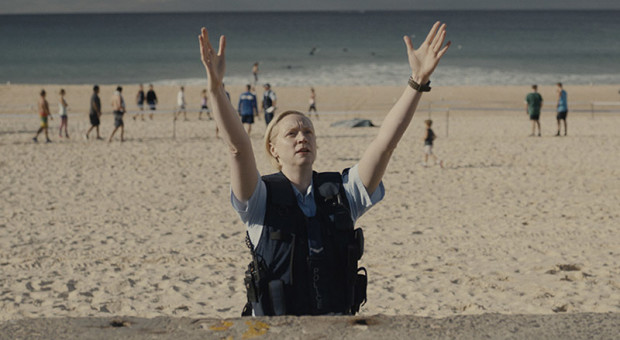
There's a moment in the final episode of this second series of Jane Campion's Top of the Lake where Nicole Kidman's character Julia reminds Elizabeth Moss's character Robin, a policewoman and our protagonist, that she, Julia, is the 'real mother' of Mary (Alice Englert), the troubled and endangered young woman at the centre of the drama. Mary is adopted: Julia raised her, whereas Robin merely gestated her. An argument about exactly what it means to be a mother is not only important in the relationship between Robin and Julia: it is key to the main plot of the drama.

A body has been found washed up on a Sydney beach, and is discovered to be that of a Thai woman working in one of Sydney's legal brothels. The dead woman was pregnant when she died, but the baby is not genetically related to her; episode 2 ends with Robin's realisation that the dead woman was acting as a surrogate. What follows is a story that weaves together the rather murky worlds of the legalised sex trade and commercial surrogacy, which is illegal under New South Wales law.

Hands up if you shouldn't be working this case!
Now, it’s worth interjecting at this stage with the observation that, if there’s one thing we learn from Top of the Lake, it’s that Australian police have some very sloppy procedures and conflict-of-interest regulations. Gwendoline Christie plays Miranda, with whom Robin is partnered in the investigation; Miranda is not only having an affair with her boss, but is also trying to have a baby by surrogacy with him. Worried that the foetus taken from the dead woman might be her own, Miranda has a bit of a barney at the office of the clinic that she patronised (matronised?). This strikes me as the sort of thing that might see a real police officer removed from a case, at the very least; but nothing at all is mentioned about it. Police officers having affairs with each other? I’m sure that happens. Police officers engaging surrogacy services? Likewise. Police officers investigating a case that straddles the boundary between legal and illegal surrogacy, at the behest of a commanding officer with whom they are trying to start a family by means of a legally-iffy surrogacy service? Is there no oversight here? At the same time, via Puss, the none-more-sleazy pimp played by David Dencik who has something to do with the illegal surrogacy racket and with whom Mary is besotted, the story is also very personal for Robin – just as was the story in the first series of Top of the Lake. Again: should she really be working on this case?

Maybe there is method in writer/ director Jane Campion’s plotting. There is a good point to be made about how our attempts to separate the private/ personal and the public/ political can only ever be partial, and that it’s often in women’s lives that we see the intersection most clearly. But there’s also a risk here of Robin becoming a slightly rough-at-the-edges Miss Marple: someone around whom Bad Things keep happening, and with whom you probably wouldn’t want to spend too long in a country house. Whether a third series of TotL would be possible without characters becoming mere ciphers for political points is unclear.

Admittedly, it’s a bit early to worry about the plausibility of a programme that might not ever be made; and the implausibilities of this series (or what one hopes, for the sake of effective policing in Australia, are implausibilities) ought not to detain us too long. For there are deep and troubling questions that the series raises.

15.8.17

Brexit, Fraud, and Law - update

A little over a year ago, I posted something about someone who had set up a crowdfunder campaign to bring a prosecution over Brexit.  I was not impressed.  I concluded by saying that the person behind it, one Marcus Ball, "should think very carefully about whether to keep his campaign going".  Of course, I'm not pompous enough to think that my opinion on this stuff counts for much, or that it'd make any contribution, or that Ball would even have read the post.  But if everyone with a blog allowed that to stop them, there'd be nothing on the internet.

I thought I'd have a look at what he's up to now.  There's still a website, but the clearest updates seem to be on the crowdfunder page.   Ball reached his initial target, so one might wonder what progress he'd made in his case.  The answer would seem to be... er... not a heck of a lot.  It appears that he contacted some lawyers, who told him in January that he didn't have a case, and he then went back to them in February with a 25 000-word document and had persuaded them that he did after all by March.  He is, though, unclear about what the legal objections were, and about how he overcame them.  One wonders why, if he is that much more competent than the lawyers he's hired at the expense of 6 000 donors, he needed them in the first place; but that's for another day.  Since then, he's written for his lawyers another pair of documents; one is 22 000 words long, and the other 10 000 words.  They must love him.  He's now asking for more money (some of which will fund a salary for him).  Hilariously, after the latest update on the BrexitJustice crowdunder, he adds a note:

3.5.17

MIFfed

I've got a bit of a dilemma.  It's a nice dilemma to have, and I know which way I'm leaning, but someone may tell me I'm being a fool.  They're wrong, but it's not quite as clear-cut as I thought it would be.

First things first: I love Manchester, and one of the things I love about Manchester is the Manchester International Festival.  It's two weeks of new and interesting art and culture, and even when a show doesn't work, as with Damon Albarn's Wonder.land a couple of years ago, it's still something that makes me proud to be a part of the city.

When tickets for MIF17 went on sale, I immediately went and spent an unholy amount on them.  I've crammed all the things I'm going to go to see into the second week of the Festival, because during the first week, I'll be in France.  This is at the invitation of one of my closest friends and her family; she lives in Australia now, so I only get to see her (and them) every couple of years.  So the final few days of June and the first few days of July are going to be packed, but great.  I'm really, really looking forward to them.

Except...

15.2.17

In which I Learn Persian

Back at the start of the academic year, I signed up for a course of beginners' Persian.  I've been a bit of a Persephile for as long as I can remember, and meaning to take lessons in the language for ages.  Then I learned that the University offers language classes to the public, and that Persian is on the menu.

So I signed up.

It was either that, or blowing the cobwebs of French, or grinding the rust off Russian, or starting German from scratch.  All had their advantages.  But I chose Persian.

Lessons are for three hours on a Tuesday evening; I've been providing a potted précis on Facebook week-by-week since.  But it might be interesting to repost those updates here, with a little elaboration as I deem fit.  I'm going to try to ensure that they appear in "real time" - to the greatest extent possible, the posts will not alter according to what I would come to know or think later.  Having said that, it might be impossible to add to what I was thinking at the time without that kind of distortion.  We shall see.

So, over the next few days, that's what I'll do.  Spoiler alert: I'm not very good at it.

In the meantime, here's a couple of photos from my trip to Iran in 2004.  (Some people go on package tours to the Algarve.  I went to a totalitarian theocracy - albeit one where the totalitarian theocracy seemed only to be skin-deep.)

This was taken in Yazd, where I ended up with sunstroke.  Annoyingly, I can't remember the names of most of the other people who were in the group.  I think the guy with the moustache that you can half-see was Paul.  But I do remember the name of the guy in the foregroud.  He was a German teacher from Aberdeen called Kenny.  Kenny had a very low tolerance for bullshit - in Esfahan, for example, he noticed that there was someone who was following us around during a bit of free time when he, I, and one or two others went for a wander around the city.  He was suspicious that our shadow might have been a policeman of some sort, so went to engage him in conversation.

In the course of that conversation, our shadow claimed that he'd worked in Germany for 20 years.  Naturally, Kenny responded by talking in German.  The shadow had no clue what he was on about.
"But I thought you lived in Germany for two decades?"
"Yes, but we never left our compound."
"For twenty years?"
"..."

Iranian police informers need to be a bit less obvious, I think.

Kenny also had a habit of joking that he was the Hidden Imam.  While the jokes were in English, they were also in public.  I'm not sure of the wisdom of that.

Anyway.

Here's another photo, this time taken under the Khaju bridge in Esfahan.  There's no story that attaches to it in any way; I don't know who the man is.  However, I do like the photo for a couple of reasons.  First, it's one of the rare pictures that I've managed to centre more or less correctly, so the perspective is good.  Second - I can take no credit for this at all - I like the way that the guy's outline follows the lines of perspective: his right arm following the vertical axis, and the line from his head to his left shoulder following the diagonal from the centre to the bottom right.  There's another reason on top of those that I like it, which is that there's a very similar photo that's on the cover of a fairly popular book - though I can't remember for the life of me what it is.  Anyway: that version of the photo on the book doesn't have anyone in it.  I think my picture is better.

So there we are.  The drip-feed record of my adventures in the language will begin anon; in a couple of weeks, we'll be up to the present.  Maybe one or two people will be interested.

14.2.17

"Denial" and Disinterest

Having taken myself off to see Denial the other night, I've been thinking about its portrayal of law - specifically, how it's done in the English courtroom.

The film that tells the story of Holocaust-denying Nazi third-rate historian David Irving's libel suit against Deborah Lipstadt.  His complaint was, basically, that she shouldn't have called him a Holocaust-denying Nazi third-rate historian, and that in doing so she was a big meanie, and booooo!  And, of course, as everyone knows, he lost.  This is why I can call him a Holocaust-denying Nazi third-rate historian here with impunity.  (Well, under the terms of the 2013 Defamation Act, I probably could anyway: the requirement for serious harm would mean that a blog with a readership as low as this would slip through the net.  But the point stands.  English law was satisfied that David Irving is a Holocaust-denying Nazi third-rate historian.)

One of the plot points - can one talk about a plot when one is aiming to represent reality?  I suppose you can: you can't distill a dispute that lasted years into a couple of hours without (a) deciding that there's a story worth telling there, (b) where the main parts of that story are to be found, and (c) weaving them into a plot - Anyway: one of the plot points concerns the way that English libel laws worked at the time.  These laws famously made it very hard to defend a libel action; the burden of proof would be on Lipstadt to show that she was correct, rather than on Irving to show her incorrect.  In a reversal of the normal order of legal proceedings, she'd have to prove her innocence; in effect, she'd have to show that the Holocaust happened.  Rachel Weisz' Lipstadt is clearly flummoxed by all this; and the film is plainly sympathetic to her confusion.  The English defamation laws were a mess.  (Whether they still are is for another post.)  Lipstadt is also baffled by the distinction between solicitors and barristers, meaning that it's a surprise to her that the lawyer she'd hired to take her case, and who'd be doing the donkey-work to put it together, would not be the lawyer who presented it in court.

I mean, you can see why someone not brought up on the system would think it weird.

13.7.16

Love the EU, Hate the Idiots

On Saturday, in a programme about Ted Heath, Radio 4 broadcast a clip from the Today programme the morning we entered the then EEC.  I got quite emotional about it.  I'm still heartbroken by the prospect that we'll probably leave the EU.

As such, I'm interested in any plausible political or legal moves that might be taken to ensure that we don't.  It's probably a forlorn hope, but it's something.  David Allan Green is keeping an eye on some of the legal aspects.  What's just cropped up in my twitter feed is not one of those moves.

Someone called Marcus J Ball* has set up a crowdfunder, the aim of which is to "[p]rosecute dishonest Brexit politicians and bring integrity back to British politics".  He's trying to raise at least £100k.  No, really.  Inevitably, there's  a video.  Look:


Now, I'm not a lawyer; and what law I do know revolves around the medical sphere.  Beyond that... well, it's the sort of legal awareness that one picks up from sitting in rooms with proper lawyers for a decade or so.  I'm sure that osmosis is a totally legitimate pedagogical technique - but, still, I thought it might be fun to have a look.

What does the webpage say, then?  Brace yourselves: it's... not good.

14.6.16

Do Not Adjust Your Sets

Here's something mildly diverting... although - at risk of sounding like I'm trying to get my excuses in early - whether it makes any real sense might depend on the characteristics of the screen on which you're reading it.

I'm currently in Edinburgh for the IAB, but took the opportunity to pootle off this morning to the SNGMA, where they've a Bridget Riley exhibition.  (It's small, but very good.  Well worth a visit, I'd say, though perhaps not if you've got a hangover.)  One of the paintings on show is this one:

It's called Rattle, and it's a touch over a metre and a half high, by almost four metres long.  It's a series of stripes, each of which is constituted by alternating sequences of diagonals in red bordered with green (which look a bit orange), and red bordered with blue (which look a bit pink).

But here's the thing: the intensity of the colour seems to depend on the direction of the diagonals.  To my eye, the bends sinisters (top right to bottom left, as we look at it) seem to have a much deeper and more vibrant hue than the bends dexters.  I wondered if it was just my eyes, but I asked a couple of other people who were there, and they agreed.  It's just occurred to me that maybe they were just being polite, but I'll take them at their word.

The picture I've just used is one I downloaded; here's a detail from the painting that I photographed myself.  The effect is lost a little in translation from reality to camera to blog, but I think it's just about visible in the two "pink" stripes; the lower one, to my eye, seems to be more intense than the upper one.  Oddly, the bends dexters in the "orange" rows now look to be the more intense to me here, which was not the case when I looked at the painting directly a couple of hours ago.  That in itself is possibly worth noting.

I wondered if the effect would be preserved in black-and-white; and I think it is.

Look at the top three rows in the reproduction on the right here; the top one, the third, and the fifth one down are pink-looing in real life, and the one between them is orange-looking.  But the top row and the third do look to be different even here - darker in the bend sinister than in the bend dexter.  Rows 4 and 5 look to be more similar to each other than rows 3 and 5.  Had I not seen the colour version, I think I'd be inclined to guess that 4 and 5 were the same colour in real life, and 3 different from both.

Or maybe I'm just trying to persuade myself now.  It's a bit hard to tell.

So that's mildly interesting.

5.6.16

The Narcissism of it All

In the end, it's the narcissism of it all.

There's something oddly fascinating about the Brexit campaign.  I think it's factually wrong about a lot of stuff, bullshitting on a good deal more, and out-and-out mendacious on some.  A case in point is the £350m-a-week claim; it might have been forgivable to state that at one stage, but once it's been so thoroughly rebutted, to keep making it implies either a desire to deceive (which at least implies that the truth is important qua something to be avoided), or an utter contempt for truth.  I have to admit that there's a degree of bullshit to the remain campaign as well (not as much, I don't think, but some), and likely as not a few errors too - though I'm not aware of any outright lies.  That economy with the truth is, regrettably, to be expected.  It doesn't explain, though, why I find Brexiteers to be by turns risible and infuriating.

And then it struck me - that there's a theme that unites the Brexit arguments; and that theme is a quite staggering narcissism.

Brexiteers' strongest card is, I think, the immigration one.  Lots of people are very worried about immigration; whether or not that worry is warranted is neither here nor there.  If people are worried about immigration, and the Brexit camp is willing to say that (a) they're correct to be worried, and (b) leaving the Union will do something to salve those worries, then that's a politically astute strategy.  Employment has something to do with it; benefits have something to do with it.  It's a line of argument that we first heard way back in 2004 with the last expansion of the Union: we'd be opening our doors to floods of Eastern European migrants who would come across here and take all the jobs.  To hear the Brexiteers speak, they're still doing that now.  The difference is that the problem is no longer associated just with the accession states; it's merely potential members of the EU, too - notably Turkey.

There's a Vote Leave poster on the main road from Salford to Manchester that screams TURKEY IS JOINING THE EU.  That's a bare faced lie.  But if you look at page 6 of the Vote Leave brochure, great play is made of the fact that Turkey's population is at the thick end of 80 million.  And there's an arrow heading from there right to the Thames valley.  Subliminal message: they're all going to come here.

That's some quite remarkable argumentative chutzpah; but it's also where the self-absorbtion comes in.  Why would they come here?  What is so special about the UK that the first thing that would cross the mind of the people of an accession state (or accession-possibly-at-some-pont-in-a-generation-or-so state) is to pack their bags and come to the UK?  It makes sense if you think that the UK is the land of milk and honey - finite milk and finite honey, of course: not enough for everyone - and that that's a given.  And yet, of course, the UK is not that land.  The UK is, in the end, just another country.  It's quite a nice country - we're wealthy, and there's no State oppression, and low crime, and little to no political violence; so, yes, things could be a lot worse.  And given the choice, I think I'd rather live here than in Turkey.

Yet at least some of that has to do with the fact that I've been brought up here.  I understand the culture; my ties are all here; I speak the language; the faff of getting a bank account somewhere else seems like too much to be bothered with.  But Turks probably think the same.  It might be true that the jobs are currently more and better in the UK; and that is a reason to migrate.  But there're lots of reasons not to as well.

Bluntly, the UK is not so attractive that everyone will want to come here by default.  It's strangely masturbatory to think otherwise.

Something similar goes for the economic arguments.  One of the lines for remaining is that the EU represents a huge free-trade area; free trade is good for the economy and so - when well-regulated - good for the people.  Brexiteers insist that they would negotiate free trade after leaving (which raises the question of why we'd leave to begin with, if one of the priorities afterwards would be to negotiate to secure what we'd just lost; but still...).  And they think that such a deal would be easy to negotiate, on the basis that the UK imports more from the EU than it exports to it.  That, in the mind of a Brexiteer, implies that the EU needs the UK, and would therefore be wary of putting up any trade barriers.

There's an obvious non sequitur there - the fact that they send more here doesn't mean that they depend on us in any way.  But there was a spokesman on the radio the other day whose claim was that the Germans would be loath to disrupt free trade, because of all the German cars we buy - I don't have a link, sadly, but there's someone reported as saying something very similar here.  In other words, if the UK leaves the Union, the UK will be able to dictate terms, and the rest of the Union will have no choice but to accept them.  Just how up yourself do you have to be to think that?  How much of a narcissist?

To think - as seems to be the case - that when we buy BMWs we're doing Germany a favour, and we might rescind this favour if those naughty Europeans don't play by the rules we want: to think that requires... and here, I begin to struggle for words.

It's more than a little bit repellent, if we're being perfectly frank.  But it's also insane - and it's deeply worrying for what might happen if we leave the Union.  If exit is run by the kind of twerp who thinks along those lines, then the post-exit UK is doomed for a generation.  It would struggle outside the EU even with wise leadership - but I'll admit that it might just about be OK with immense good luck and a following wind.  But if that kind of delusional thinking is indicative of what's to come...  God, it doesn't bear thinking about.  I'm increasingly worried - no, scared, that the UK is about to leave the EU.  And it's about to do so under the leadership of liars and fantasists.

And we're supposed to leave because BRITAIN, and we'll be OK afterwards because BRITAIN, and we're the greatest nation in the world because BRITAIN, and that's why everyone wants to come here - because even if we are the greatest nation in the world, we're not quite so great enough to handle non-Brits coming here and building our walls.  Still, BRITAIN, eh?  Fucking BRITAIN.

I don't pretend that any of this is a devastating insight.  I'm probably well behind the curve.  But I think it's interesting, and worth pointing out nonetheless.

Shit, I'm scared.

25.5.16

An Addendum on the Strike

Having written at length about why I'm not persuaded that a strike is a good idea when it comes to university pay disputes, I've just learned that Goldsmiths, and maybe a couple of other places, are diverting the money that would have been paid to striking staff to the student hardship fund.

Now that's the sort of thing that might win me over.  Staff would still lose out in the short term - that's part of the nature of a strike - but students would get some kind of benefit that'd begin to offset any inconvenience; and employers wouldn't be rewarded for making staff angry.  (Not all inconvenienced students would benefit, but some would; and a benefit to the student body in abstracto doesn't mean that every student in concreto would have to feel it.  That's probably all that matters.)

If I hear from my employer that there's a comparable scheme at our place, then I think I'd be persuaded.  I'd still probably work, but that's because I've got nothing better to do with my time; but I'd be much more likely to register as being on strike.

To Strike or Not To Strike?

Officially, the UCU is on strike today; the headline is that the dispute comes down to being about pay.  According to the UCU website, the real value of academic salaries has fallen 14.5% since 2009; the latest pay offer is 1.1%.  I'm not sure how the 14.5% figure is calculated, but I'll take the Union at its word.  (I don't doubt that Universities UK would dispute the figure; but even if it's mistaken, there's no reason to suppose that the UCU is speaking in bad faith.)

To be honest, when it comes to pay levels, I'm personally not all that fussed.  Larger pay rises are nicer than small ones, but academics at my level are not poorly paid by any stretch of the imagination.  But it's not about what I get personally.  What's much more worrying is the dual trend of the demands placed on us in return for that pay, and the casualisation of HE.  Everyone I know works evenings and weekends; I've had five days' annual leave in the past two years, and I worked during that; I'm not taking any holiday this year.  The idea that one might take a couple of days away from the keyboard to read and get to grips with a new book, or longer to get up to speed with a new but important topic or sub-field on work time is risible, even though doing so would obviously contribute to teaching and research.  There's no time or incentive to step back and look at how courses work and how the might be done differently.  If you're casual, you can flit between sessional gigs for years - and increasing numbers are casual.  Pay at my end of the scale may not be bad in absolute terms; but if you're starting out, it can be awful.  It isn't always; but it can be.

In many ways, the UK system is beginning to look like the US system, with all the grotesqueness that that entails... except that here (with a very few exceptions), we don't have the Prince-Bishop professoriate.  Senior academics are in pretty much the same boat as a newly-appointed junior lecturer.

We do have our Prince-Bishops, though: Vice-Chancellors' pay has gone up by quite a bit more than academics' - in one case, by about 25%.  (Falmouth has a university.  Who knew?)  The Wolverhampton VC's pay went up by 19.6%, apparently as a reward for exceptional leadership - whatever that may mean - and reflecting the "size, complexity and performance of [the] university" - as though academic staff have nothing to do with that performance.  On that basis, the hypocrisy of the 1.1% offer is stunning.

28.4.16

I Don't Understand Poetry

This post is meant as a bit of an encomium of Ian McMillan, Bard of Barnsley and potential Patron Saint of Speech Radio - though, on re-reading, I'm a bit worried that it won't sound like it.

The other morning, he posted this on twitter:
I love this poem by Norman Nicholson
The poem in question is called "Five Minutes".  Here it is:
"I'm having five minutes," he said,
Fitting the shelter of the cobble wall
Over his shoulders like a cape. His head
Was wrapped in a cap as green
As the lichened stone he sat on. The winter wind
Whined in the ashes like a saw,
And thorn and briar shook their red
Badges of hip and haw;
The fields were white with smoke of blowing lime;
Rusty iron brackets of sorel stood
In grass grey as the whiskers round an old dog's nose.
"Just five minutes," he said;
And the next day I heard that he was dead,
Having five minutes to the end of time.

I've always had a problem with poetry.  I simply don't get it; and this poem is a good example of why.  I don't understand why it can't be rendered as a paragraph, for one thing:
'I'm having five minutes,' he said, fitting the shelter of the cobble wall over his shoulders like a cape.  His head was wrapped in a cap as green as the lichened stone he sat on.  The winter wind whined in the ashes like a saw, and thorn and briar shook their red badges of hip and haw; the fields were white with smoke of blowing lime; rusty iron brackets of sorel stood in grass grey as the whiskers round an old dog's nose.  "Just five minutes," he said; and the next day I heard that he was dead, having five minutes to the end of time.
It'd be - for my money - a slightly over-baked paragraph; writing as such throws into relief what is over-done about it ("red badges of hip and haw"?  Hmmm), but for the life of me I can't see what's missing.  Indeed, it seems to be that the piece is more successful when rendered as prose, because the line breaks are distracting.  Why are they where they are?  (I can't tell that there's a rhythmic need; and the rhyme structure is too tenuous. A-B-A-C-D-E-F-E-G-H-I-F-A-G, if I've counted correctly.  Oooh: wait: 14 lines.  So does that make it a sonnet?  And why does that matter?)  In the prose version, you don't have to worry about that; but you do have the freedom to stress what you will - to pick out the rhythms and rhymes as they present themselves, without the prompt.

Anyway: I replied to McMillan, because... well, because Twitter makes you think that that's OK.  "I have never understood poetry," I wrote.  "Why couldn't this be (overbaked) prose?  Who/ what should I read to see what I'm missing?  I believe I *am* missing something, but what?  I feel like a blind man in a gallery".

21.2.16

On Voting with a Heavy Heart

Well, I'm going to vote to stay in, obviously.

I don't vote often; I have a rather tortured relationship with democracy because whether or not I approve of a person or policy has very little to do with the qualities of that person or policy, and I think that it'd be better overall if people like me just shut the hell up and left the task of running stuff to those with an education and expertise.  I voted in the last general election simply to add to the weight of votes against UKIP, rather than out of any positive choice.  All the same, I shall put my scepticism about plebiscites and elections to one side in June, and I shall vote for the UK to stay in the EU.  But I shall do so with a heavy heart.  Why so?  Because the terms on which the referendum is to be held are so dispiriting.

The syntactically-clunky wording of the referendum will be
Should the United Kingdom remain a member of the European Union or leave the European Union?
This was at the behest of the Electoral Commission; the European Union Referendum Act (2015) has  a couple of formulations of the ballot.  Technically, neither wording has anything much to do with what David Cameron has just negotiated; but for him to ditch that negotiation would be such an act of brass neck that it's fair to say that the bindingness of the referendum will be tied to the agreement reached on the 19th: should anyone try to depart from that agreement, there'd be significant pressure to overturn the referendum result.  (I predict that that'll be UKIP's strategy whatever happens: insist that the deal is not being enforced properly by those dastardly Europeans, therefore they're acting in bad faith, therefore leave.  The result will make no difference at all to the likes of Farage.)  To all intents and purposes it's a referendum on an agreement that noone will read, and that the Leave side would reject no matter what it said unless it said "leave now".  But the agreement is central; and this is the problem.

1.1.16

Rhodes to Palmyra

There are many things that look to be superficially alike, but that careful examination shows to be very different.  Sharks and dolphins are both grey-ish aquatic predators with a prominent dorsal fin.  It is not wholly unreasonable for someone unfamiliar with them to suppose that they are closely related: a child, or - less plausibly - a marine biologist visiting from another planet might make that mistake.  But closer inspection would reveal significant differences; and one would hope that the child or alien biologist would move away from thinking them the same sort of thing.  One would hope that a tolerably well-informed adult would have stopped making that kind of mistake a long time before, and would not get a newspaper column asserting that dolphins and sharks are very similar indeed.

This serves as a sort of preamble to a rumination on a story that broke a couple of weeks ago: that Oriel, Oxford, was considering removing a statue of Cecil Rhodes after coming under pressure from student protestors.  These protests echo similar protests in South Africa.

The rationale for getting shot of the guy is straightforward enough: that he was racist, imperialist, and not the sort of person whom modern academia should be honouring if it's ever going to stand a chance of becoming the post-racist, post-imperial community to which it aspires.  I've a certain amount of sympathy for this view - particularly in respect of the South African protests; after all, the colonial and post-colonial history of that country has been particularly bitter for the majority of the population.  Having a monument to him at Oriel strikes me as being slightly morally different, though I can't put my finger on why - so maybe it isn't that different after all.

On the other hand, there are counterarguments.  Rhodes was a man of his time; it is naive to pretend that we can, or should, whitewash history; if we want to understand where we are and to control where we're going, it pays to remember whence we came; and, anyway, Rhodes' personal legacy has enabled students from all around the world, of all races, to study at Oxford.  His reputation may be tarnished, but it is not without burnished bits as well.

The point is that the arguments about whether Rhodes must fall are complex, and worth hearing from both sides.

Not everyone seems to think this.

9.12.15

You Ain't No True Scotsman, Bruv!

Maybe I've missed it, or blocked it out, but we seem to have been spared the regular pieties in the wake of the Paris terrorist attacks - the ones trotted out by all mainstream politicians about how the true Islam is tolerant and peaceful, and terrorism has nothing to do with Islam.  That line doesn't seem to have had much of an airing.

For this, I am grateful.

Let's be honest: it's not true that jihadi or Islamist* terrorism has nothing to do with Islam.  It plainly does have something to do with it.  This in no way means that Islam is, or has to be, a violent religion; and I do believe that most Muslims are horrified by what's being done in the name of their religion.  There's a #notinmyname hashtag that testifies to this.  I don't think that people using it are liars, and I think also that the overwhelming majority of Muslims who haven't used it are likely to be in agreement with it.  But, howsoever tenuously, it is something to do with Islam.

In just the same way, witch-burnings have something to do with Christianity.  The Westboro Baptist Church has something to do with Christianity.  Neither is not the whole of Christianity, by any means.  Not even most, or a significant part of it.  But it is there.

It does noone any good in the long term to pretend otherwise, and denying this seems to be a version of the No-True-Scotsman fallacy:
N claims to be a Muslim
N commits some crime in the name of Islam
N turns out not to have been a true Muslim after all.
So when a witness shouted at the attacker in Leytonstone that "You ain't no Muslim, bruv", and it became a slogan for showing opposition to religiously-informed violence: well, it's an admirable sentiment, but... behaving violently in the name of a religion doesn't disqualify one from membership thereof.  A bad Muslim is still a Muslim, and its disingenuous to insist that Islam can be separated from reprehensible acts as a matter of principle in something like the way that being a Scot can be separated from taking sugar on your porridge in principle.

Actually, it's more than that.  It's empty dogmatism to insist that Islam as a matter of principle must be beyond criticism, and therefore anything that is liable to criticism must have nothing to do with Islam.

But I don't want this to be a post about Islam; my concern is more general, and it has to do with the rhetoric of being a "true" adherent to whatever the creed under consideration is.  Let's talk about it in terms of Pastafarianism, just to be as neutral as possible.

What is it to be a "true" Pastafarian?

30.11.15

So. Syria, then.

I don't know.

They're going to hold a vote in Parliament about whether to begin air strikes against ISIS targets in Syria.

Everyone seems to have an opinion on this.  Lots of people think that it's a good thing.  Lots of people seem to think that it's a bad thing.

I suppose that I'm expected to have a view in some way.  Workings of democracy, and all that nonsense.  Need to be engaged.  Important to take a stand.

It's hard to take a stand.

I don't know.

Dropping bombs on ISIS will make us de facto allies of President Assad, at least for the short term.  President Assad is deeply unpleasant.  We probably don't want to be allies with him.

BUT...  President Assad is, whatever else he may be, an astute politician.  He wants power, or survival if power's not available; not martyrdom.  He is at least on nodding terms with secularism; he isn't fighting a holy war.  His war is one of politics.  That makes him, at least on paper, the kind of person with whom negotiations are possible, and who will be concerned about when the game's up.

Maybe we should offer him a secure and peaceful retirement in London.  "When this is over, Bashar, just fuck off from Damascus, eh?  We'll make sure you're personally fine.  That's a price worth paying.  Just go quietly.  Good chap.  London suit you?  Geneva?  Moscow?  Tehran?  Your choice.  Just never go back to Syria.  Deal?"

ISIS are not, as far as I can see, in the slightest bit concerned about when the games up.  They'll think that surviving is a victory.  They'll think that being killed is a victory.

Assad might well be much the better of two evils.

The gratuitous sadism, and the cultural vandalism of ISIS are plenty of evidence for that to be the case.

So.

I don't know if dropping bombs on ISIS will work.  I'm inclined to think that it won't.

I don't know if refraining from dropping bombs on ISIS will work.  I'm inclined to think that it won't.

The kicker: I don't know what "working" would be anyway.

I can't be the only one who doesn't know this stuff.

There's a lot of coverage in the news who are certain one way or the other.

There's not so much of those who genuinely have no idea.  I think that there's a lot of us, though.

I don't even know if the certain people should be less certain.

I don't know where to begin.