It's been a while since I posted a Persian update here; it was difficult to keep much momentum when the basic alteration from one week to the next was "Learned a bit, forgot a bit, didn't make much progress". I didn't complete any of my summer exam because I looked at the page and simply couldn't read a word of it. It took me a while to un-freeze my brain; and by that time, the semester was over and there were no lessons.
My erstwhile teacher has said I should come along to the next level of lessons all the same; but I don't think I'd be up to it - and, anyway, they don't fit easily with my other commitments. I may resit the beginners' course in semester 2.
In the meantime, and in addition, I've found another Persian teacher, with whom I'm having one-to-one lessons via skype. Slowly, slowly, I'm making up ground. But... well, you know there's going to be a but.
It turns out that what I'd been learning at the University last year was very, very formal and rather outdated; were I to turn up in Tehran and speak to people, it'd be somewhat as if Jane Austen were to materialise here. OK: I'd be understood, but people'd be puzzled, and I might not understand them too well. What I'm learning now is much more colloquial. Pronunciation is slightly different, with syllables dropped or contracted into each other; some of the long alephs become vavs, too: thus, for example, "they", آنها (anhā), becomes اونا (unā). I've also learned that a lot of people really struggle with dipthongs including the vav - many younger Iranians wish it'd just go away. Thus "sister", خواهر (khahar), is sometimes contracted to خاهر, on the basis that the و doesn't do anything. If you're sending a text, those spare characters can be important! Granted, this kind of shift isn't the sort of thing about which I have to worry a great deal, but the point stands that classroom Persian and everyday Persian sometimes come apart.
(Incidentally, I struggle to pronounce خواهر, however you want to spell it. It's something like khahar; but there's something about the differentiation of the "kh"
sound of the خ, and the "h" of the ه that I struggle to make, and I
keep pronouncing the first "a" more like "ar", too. I don't know why I
have a mental block about it - but, on the other hand, I don't have a
sister either, so it may not matter much all things considered.)
On a slightly deeper level, most verbs in the simple present are indicated by the prefix mi-. Hence "To come", آومدن (amadan), becomes man mi'am, to mi'ai, u mi'ad for I/ you/ he or she come(s); "To eat", خوردن (hourdan) becomes man mi'houram, to mi'houri, u mi'houreh. But some aren't: for example, "To have", داشتن (dāshtan) becomes man daram, to dari, u dareh - except when it doesn't; hence one could say "man mi'daram" for "I have", and people'd think you're from Shiraz, because Shirazis do use the mi- prefix. (Note that the ending of the third person singular is something else that shifts is colloquial Persian; I'd initially learned that verb endings were basically -m, -i, -d, -im, -id, nd; but they're often, albeit not always, -m, -i, -eh, -im, -id, -n in real life.)

10.10.17
"Top of the Lake" may Sink as a Procedural, but Look Beneath the Surface
A couple of weeks ago, BioNews invited me to review Top of the Lake; this is the version I submitted there, free - for better or worse - of editorial cuts.
There's a moment in the final episode of this second series of Jane Campion's Top of the Lake where Nicole Kidman's character Julia reminds Elizabeth Moss's character Robin, a policewoman and our protagonist, that she, Julia, is the 'real mother' of Mary (Alice Englert), the troubled and endangered young woman at the centre of the drama. Mary is adopted: Julia raised her, whereas Robin merely gestated her. An argument about exactly what it means to be a mother is not only important in the relationship between Robin and Julia: it is key to the main plot of the drama.
A body has been found washed up on a Sydney beach, and is discovered to be that of a Thai woman working in one of Sydney's legal brothels. The dead woman was pregnant when she died, but the baby is not genetically related to her; episode 2 ends with Robin's realisation that the dead woman was acting as a surrogate. What follows is a story that weaves together the rather murky worlds of the legalised sex trade and commercial surrogacy, which is illegal under New South Wales law.
Now, it’s worth interjecting at this stage with the observation that, if there’s one thing we learn from Top of the Lake, it’s that Australian police have some very sloppy procedures and conflict-of-interest regulations. Gwendoline Christie plays Miranda, with whom Robin is partnered in the investigation; Miranda is not only having an affair with her boss, but is also trying to have a baby by surrogacy with him. Worried that the foetus taken from the dead woman might be her own, Miranda has a bit of a barney at the office of the clinic that she patronised (matronised?). This strikes me as the sort of thing that might see a real police officer removed from a case, at the very least; but nothing at all is mentioned about it. Police officers having affairs with each other? I’m sure that happens. Police officers engaging surrogacy services? Likewise. Police officers investigating a case that straddles the boundary between legal and illegal surrogacy, at the behest of a commanding officer with whom they are trying to start a family by means of a legally-iffy surrogacy service? Is there no oversight here? At the same time, via Puss, the none-more-sleazy pimp played by David Dencik who has something to do with the illegal surrogacy racket and with whom Mary is besotted, the story is also very personal for Robin – just as was the story in the first series of Top of the Lake. Again: should she really be working on this case?
Maybe there is method in writer/ director Jane Campion’s plotting. There is a good point to be made about how our attempts to separate the private/ personal and the public/ political can only ever be partial, and that it’s often in women’s lives that we see the intersection most clearly. But there’s also a risk here of Robin becoming a slightly rough-at-the-edges Miss Marple: someone around whom Bad Things keep happening, and with whom you probably wouldn’t want to spend too long in a country house. Whether a third series of TotL would be possible without characters becoming mere ciphers for political points is unclear.
Admittedly, it’s a bit early to worry about the plausibility of a programme that might not ever be made; and the implausibilities of this series (or what one hopes, for the sake of effective policing in Australia, are implausibilities) ought not to detain us too long. For there are deep and troubling questions that the series raises.
There's a moment in the final episode of this second series of Jane Campion's Top of the Lake where Nicole Kidman's character Julia reminds Elizabeth Moss's character Robin, a policewoman and our protagonist, that she, Julia, is the 'real mother' of Mary (Alice Englert), the troubled and endangered young woman at the centre of the drama. Mary is adopted: Julia raised her, whereas Robin merely gestated her. An argument about exactly what it means to be a mother is not only important in the relationship between Robin and Julia: it is key to the main plot of the drama.
A body has been found washed up on a Sydney beach, and is discovered to be that of a Thai woman working in one of Sydney's legal brothels. The dead woman was pregnant when she died, but the baby is not genetically related to her; episode 2 ends with Robin's realisation that the dead woman was acting as a surrogate. What follows is a story that weaves together the rather murky worlds of the legalised sex trade and commercial surrogacy, which is illegal under New South Wales law.
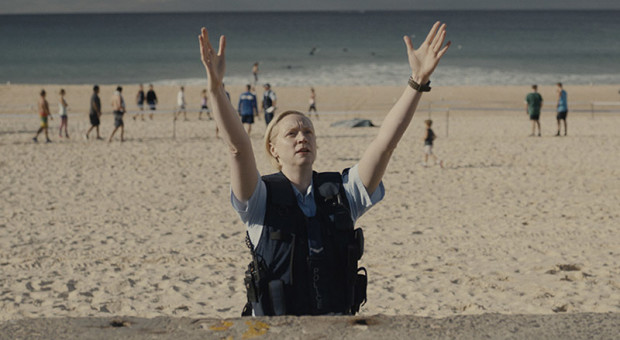 |
| Hands up if you shouldn't be working this case! |
Maybe there is method in writer/ director Jane Campion’s plotting. There is a good point to be made about how our attempts to separate the private/ personal and the public/ political can only ever be partial, and that it’s often in women’s lives that we see the intersection most clearly. But there’s also a risk here of Robin becoming a slightly rough-at-the-edges Miss Marple: someone around whom Bad Things keep happening, and with whom you probably wouldn’t want to spend too long in a country house. Whether a third series of TotL would be possible without characters becoming mere ciphers for political points is unclear.
Admittedly, it’s a bit early to worry about the plausibility of a programme that might not ever be made; and the implausibilities of this series (or what one hopes, for the sake of effective policing in Australia, are implausibilities) ought not to detain us too long. For there are deep and troubling questions that the series raises.
15.8.17
Brexit, Fraud, and Law - update
A little over a year ago, I posted something about someone who had set up a crowdfunder campaign to bring a prosecution over Brexit. I was not impressed. I concluded by saying that the person behind it, one Marcus Ball, "should think very carefully about whether to keep his campaign going". Of course, I'm not pompous enough to think that my opinion on this stuff counts for much, or that it'd make any contribution, or that Ball would even have read the post. But if everyone with a blog allowed that to stop them, there'd be nothing on the internet.
I thought I'd have a look at what he's up to now. There's still a website, but the clearest updates seem to be on the crowdfunder page. Ball reached his initial target, so one might wonder what progress he'd made in his case. The answer would seem to be... er... not a heck of a lot. It appears that he contacted some lawyers, who told him in January that he didn't have a case, and he then went back to them in February with a 25 000-word document and had persuaded them that he did after all by March. He is, though, unclear about what the legal objections were, and about how he overcame them. One wonders why, if he is that much more competent than the lawyers he's hired at the expense of 6 000 donors, he needed them in the first place; but that's for another day. Since then, he's written for his lawyers another pair of documents; one is 22 000 words long, and the other 10 000 words. They must love him. He's now asking for more money (some of which will fund a salary for him). Hilariously, after the latest update on the BrexitJustice crowdunder, he adds a note:
11.8.17
Charlie Gard: An Ethical Analysis of a Legal non-Problem
(This is an extended version of a post that originally appeared at EJIL: Talk!)
For those with an internet connection and an interest in current affairs, the story of Charlie Gard been hard to avoid recently. A decent précis is available here; but it’s worth rehearsing.
Shortly after his birth, Charlie’s health began to deteriorate, and he was diagnosed with a terminal and incurable mitochondrial DNA depletion syndrome. By March 2017, Charlie needed artificial ventilation, and doctors at Great Ormond Street Children’s Hospital (GOSH) applied to the High Court for confirmation that removing that ventilation would be lawful, having judged that it was not in his best interests. This was contested by his parents, Chris Gard and Connie Yates; the High Court ruled in favour of GOSH. This was confirmed by the Supreme Court and the European Court of Human Rights. During all this time, Charlie remained ventilated.
In the High Court, Mr Justice Francis said that his decision was subject to revision should new evidence emerge favouring continued treatment; in July, Charlie’s parents returned to the High Court, claiming that Charlie might benefit from an experimental treatment being offered by Professor Michio Hirano of Columbia University. However, as proceedings advanced, it became clear that Hirano’s proposed treatment had never been used on patients like Charlie, that he had neither seen Charlie nor read his notes when he offered the treatment, and that he had a financial interest in that treatment. The position statement issued by GOSH on the 24th July barely hides the hospital’s legal team’s exasperation. On the 24th July, Charlie’s parents dropped their request for continued treatment. The details of Charlie’s palliative care were still disputed; his parents wanted it to be provided at home, with ventilation maintained for a few days. The High Court ruled against this on the 27th July. Charlie was moved to a hospice; his ventilator was removed, and he died on the 28th July, a few days before his first birthday.
The way this case has played out has not been pretty. Elements of the American media (this piece is one among many) and the political right wing used it to launch attacks on single-payer healthcare systems:
Legally, the case was very straightforward.
For those with an internet connection and an interest in current affairs, the story of Charlie Gard been hard to avoid recently. A decent précis is available here; but it’s worth rehearsing.
Shortly after his birth, Charlie’s health began to deteriorate, and he was diagnosed with a terminal and incurable mitochondrial DNA depletion syndrome. By March 2017, Charlie needed artificial ventilation, and doctors at Great Ormond Street Children’s Hospital (GOSH) applied to the High Court for confirmation that removing that ventilation would be lawful, having judged that it was not in his best interests. This was contested by his parents, Chris Gard and Connie Yates; the High Court ruled in favour of GOSH. This was confirmed by the Supreme Court and the European Court of Human Rights. During all this time, Charlie remained ventilated.
In the High Court, Mr Justice Francis said that his decision was subject to revision should new evidence emerge favouring continued treatment; in July, Charlie’s parents returned to the High Court, claiming that Charlie might benefit from an experimental treatment being offered by Professor Michio Hirano of Columbia University. However, as proceedings advanced, it became clear that Hirano’s proposed treatment had never been used on patients like Charlie, that he had neither seen Charlie nor read his notes when he offered the treatment, and that he had a financial interest in that treatment. The position statement issued by GOSH on the 24th July barely hides the hospital’s legal team’s exasperation. On the 24th July, Charlie’s parents dropped their request for continued treatment. The details of Charlie’s palliative care were still disputed; his parents wanted it to be provided at home, with ventilation maintained for a few days. The High Court ruled against this on the 27th July. Charlie was moved to a hospice; his ventilator was removed, and he died on the 28th July, a few days before his first birthday.
The way this case has played out has not been pretty. Elements of the American media (this piece is one among many) and the political right wing used it to launch attacks on single-payer healthcare systems:
Nigel Farage weighed in, complaining about the state taking away parental rights:Our hearts weep for #CharlieGard Our prayers are w/ him. Pls read & ask WHY govt should have power to decide who lives & dies. It's wrong. https://t.co/MsvoJBqJyO
— Ted Cruz (@tedcruz) July 24, 2017
From the left, Giles Fraser wrote that the case was being dealt with too rationally. None of these claims is justified, and many left-leaning people have been surprised to find themselves in agreement with Melanie Phillips on this matter.UK medical establishment closed ranks on #CharlieGard's parents & the state took away their rights. Change required. What a total disgrace. pic.twitter.com/TRBWWYTwJb
— Nigel Farage (@Nigel_Farage) July 24, 2017
Legally, the case was very straightforward.
3.8.17
Dunkirk, British, and the Germans
OK. So I went to see Dunkirk, because the reviews have been almost universally excellent, and because (a) it was endorsed by Nigel Farage, and (b) everyone pointed out that Farage had missed the point. Farage missing the point is hardly news; but I wanted to see how he'd missed it.
(In what follows, there may be spoilers. But since what actually happened at Dunkirk is a matter of record, and since there're no twists, I'm not too fussed about that. I'll say a little about a couple of characters, but nothing that'll mar the film.)
Now, I can see why Brexiteers are getting all excited about the film. Dunkirk is part of the British national story, and anything that tells a story about plucky British fortitude in the face of a threat from Ze Hun is going automatically to have them wanking themselves square then round again. In other words, it matters little what the content of the film actually was: it'd've been coopted into the Brexit narrative somehow. No contortion would have been too wild, because if you've got a fixed idea about that threat and a need for the British to retreat back to the safety of Blighty in the face of a threat from the Continent... well, you get the picture.
And I know I have an idée fixe about Brexit from the other side, too. But this is my blog, so you'll have to lump it.
Anyway: back to the point I was going to make, which is that those Brexiteers have missed the point entirely. Dunkirk's an avowedly anti-nationalist film. And that's apparent from the first minute - from before any character appears on the screen.
The first thing we see is a one-sentence preamble telling us about how the British and French armies have been forced into retreat by "the enemy". Note that Christopher Nolan doesn't talk about the Allied forces being forced into retreat by "the Germans" or "the German Army" or anything like that. "The enemy" is in a way more menacing - but it's hard to see how it's anything other than a deliberate move so as not to name the Germans. One might go a bit further, and infer that Nolan is indicating that Nazism was not German, or at least that there's a clear distinction to be made between what might have been done in the name of Germany and what was done in the name of the Third Reich. There might be mileage in that - lots of contemporary Germanophiles thought so - but it's not a rabbit I want to chase here. It's enough to point out that, in the most obvious way, Nolan has deliberately avoided making this a story about Germans and Englishmen.
Thus primed, I would encourage anyone who's not seen the film to count how many times the word "German" or its cognates is used. I did: I think it's four. In all cases (which appear over about 3 minutes in total), it's used as an accusation of untrustworthiness. So far, so standard war-movie. But it's always from the same character. And that character is a terrified, paranoid, dangerous idiot, who is looking for someone to blame, and someone to shoot.
That is: the only person who makes a direct reference to Germans is someone with whom you wouldn't want to be in a confined space. Other British characters are, by turns, doughty, brave, or - in a couple of cases - cowards. In other words, they're exactly like most people. They are not made saintly by dint of being British.
Now, there are atrocities committed by the enemy. A ship that's clearly marked with a red cross is bombed. I don't know if that happened in reality. But even there, the bomb is from a machine. We don't see the face of the pilot. By and large, the enemy is unseen. There is a brief moment when we see actual members of the Wehrmacht; but in that moment, when it would be very easy for them to kill a defenceless man, they don't. They are not made evil by dint of being German.
In other words, the enemy can't be identified with a particular nation. We know the origin of the enemy, but Nolan doesn't labour the point. Nation doesn't really matter to the film he's made, which is about people in a situation behaving as people do. He could have made appreciably the same film about any conflict, real or fictional. Hell, he didn't even really need a conflict. Except that, by making a film set in the second world war and not talking about nations or national character, he gives quite a clear message about nations and national character.
Quite clear, but not clear enough for some. Farage doesn't really do nuance, and he can't really see beyond the nation. It's little wonder he misunderstood what he saw.
3.5.17
MIFfed
I've got a bit of a dilemma. It's a nice dilemma to have, and I know which way I'm leaning, but someone may tell me I'm being a fool. They're wrong, but it's not quite as clear-cut as I thought it would be.
First things first: I love Manchester, and one of the things I love about Manchester is the Manchester International Festival. It's two weeks of new and interesting art and culture, and even when a show doesn't work, as with Damon Albarn's Wonder.land a couple of years ago, it's still something that makes me proud to be a part of the city.
When tickets for MIF17 went on sale, I immediately went and spent an unholy amount on them. I've crammed all the things I'm going to go to see into the second week of the Festival, because during the first week, I'll be in France. This is at the invitation of one of my closest friends and her family; she lives in Australia now, so I only get to see her (and them) every couple of years. So the final few days of June and the first few days of July are going to be packed, but great. I'm really, really looking forward to them.
Except...
First things first: I love Manchester, and one of the things I love about Manchester is the Manchester International Festival. It's two weeks of new and interesting art and culture, and even when a show doesn't work, as with Damon Albarn's Wonder.land a couple of years ago, it's still something that makes me proud to be a part of the city.
When tickets for MIF17 went on sale, I immediately went and spent an unholy amount on them. I've crammed all the things I'm going to go to see into the second week of the Festival, because during the first week, I'll be in France. This is at the invitation of one of my closest friends and her family; she lives in Australia now, so I only get to see her (and them) every couple of years. So the final few days of June and the first few days of July are going to be packed, but great. I'm really, really looking forward to them.
Except...
14.4.17
Law Changes and Slippery Slopes
(Cross-posted from the other place)
Apparently, there was a TV programme in Australia the other day in which a there was a discussion of assisted dying. It got reported in The Guardian, largely on the basis that an 81-year-old audience member kept calling Margaret Somerville "darling" and then got mildly sweary. I've only seen those clips from the programme that are linked in the Graun's report, so I'm not going to comment on the tone of the debate in particular. Rather, I'm interested in one of the responses to the programme, from Xavier Symons, writing in The Conversation.
Symons takes the opportunity to unpick the idea of a slippery slope argument - in this case, the claim that allowing some forms of assisted dying will commit us to allowing... well, that's open-ended, but it's sufficient to say that it'd be terrible. We'd want to avoid terrible things; therefore, the argument goes, we shouldn't allow any of it. This is well-worn stuff in the seminar room, but it's a mode of argument that refuses to die. Quite correctly, Symons points out that
So far, so standard. (I'd say "unsound" rather than "invalid", because the validity of an argument doesn't depend on its evidence - or, at least, not in the same way; but that's a small matter.) He then makes another move, which is a bit more interesting:there is a need for empirical evidence or sound inferential reasoning to support the claim that event B will necessarily (or probably) follow on from event A. Without this evidence, the argument is invalid. I can’t just claim, for example, that the legalisation of medicinal marijuana leads to the legalisation of ice - I need to show some empirical or logical connection between the two.
Is this correct?But (and it’s a big but) there is such a thing as a good and valid slippery slope argument. A good slippery slope argument demonstrates a causal or probable relationship between event A and B, such that event B can legitimately be expected to occur if event A is allowed to occur. [...] There are, nevertheless, compelling empirical and logical slippery slope arguments available to defend more modest claims about the “normalisation” of assisted dying.

Subscribe to:
Posts (Atom)